





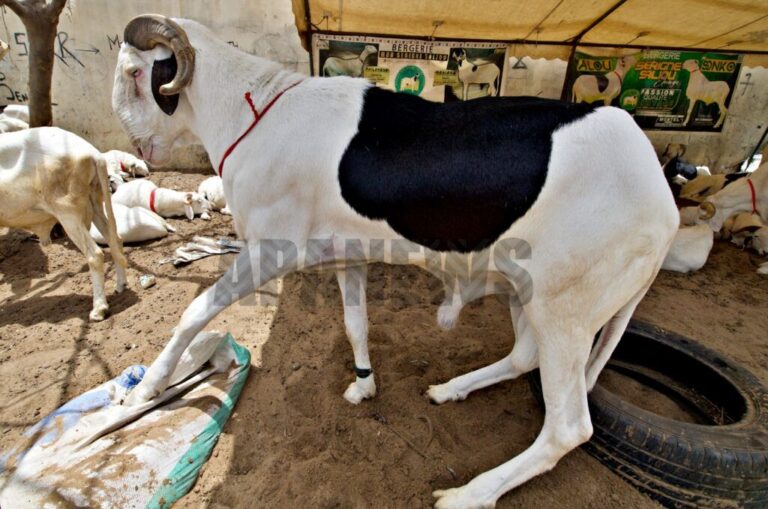
With only a few days until Eid al-Adha (Tabaski) in Senegal, some sheep are going for dizzying prices.
Behind these price tags of several million CFA francs lies an investment strategy that breeders fully embrace, and which scientific research confirms. On the two lanes of Liberte 6, Ibrahima Kamissokho, known as “Ibou Ngatte,” proudly displays a three-year-old ram.
The asking price is 1.5 million CFA francs. The animal is calm and imposing. Around him are curious onlookers, but few buyers.
Yet, the 42-year-old breeder is in no hurry to part with him.
“Forty-eight hours after he came out, I received two offers of one million francs. I refused,” he confides. His reason is simple: “His offspring alone is worth a million; and with him, we’ve had at least five or six sets of offspring;” a Senegalese Giant”
The animal that Ibou Ngatte refuses to sell off cheaply is no ordinary sheep. The Ladoum is a sheep breed specifically from Senegal, which appeared around the beginning of the 2000s, and whose exceptional physical characteristics alone explain the soaring prices. Its origin remains debated: some researchers believe it resulted from a long selection process carried out by a breeder from Thies, using Toulabire sheep since the 1970s.
Others suggest an introduction from Kayes, in western Mali. A genetic characterisation study confirms that the Ladoum is “a subpopulation of the Toulabire sheep,” this Sahelian crossbreed with short hair found in Mauritania.
Research conducted jointly by the Senegalese Institute for Agricultural Research (ISRA) and Cheikh Anta Diop University (UCAD) in the Dakar, Thies and Diourbel regions paints a striking portrait of
the breed. An adult Ladoum ram reaches an average height of 104 centimetres at the withers, roughly the height of a five-year-old child, with an average chest circumference of 116 centimetres.
Recorded extremes reach up to 114 centimetres in height and 132 centimeters in chest circumference. Females average 97 centimetres at the withers. The researchers conclude that sexual dimorphism is “very pronounced” and “highly significant.”
Another unique feature in the West African sheep landscape is that all males are horned, with horns averaging 35.8 centimetres in length and often bicolored. Females also have horns in over 82% of cases, an exception in a region where the majority of female sheep breeds are hornless. As for coat colour, it is a significant factor in terms of commercial value: white with black spots is the most common (33% of individuals), followed by solid white (23.6%) and white with black patches (22.2%).
Breeders are adamant: a purebred Ladoum sheep “never has ‘pendants,'” those small spherical appendages on its neck. Their presence, observed in only 1.39% of the animals studied, is considered a sign of crossbreeding, and therefore of immediate commercial downgrade.
A breeding program for traders and civil servants
The profile of Ladoum breeders is itself revealing. A study conducted with 84 livestock farmers in the municipality of Thies by researchers from the University of Thies paints a surprising picture: they are predominantly traders (57%) and civil servants (18%), all educated, with an average age of 51.
These are individuals with multiple occupations, for whom livestock farming is a secondary activity with significant symbolic and financial returns.
The three stated motivations for raising Ladoum sheep are: improved income (78.57%), attachment to the animals (23.1%), and social prestige (8.33%). This last criterion, cited by a minority, is probably underestimated: the researchers note that “raising Ladoum sheep is considered by some as a prestigious activity” that “is increasingly attracting certain socio-professional categories.”
This perfectly describes Ibou Ngatte: a former network and telecommunications technician who worked for SONATEL, and who switched to livestock farming out of both passion and business acumen. He speaks of his animals as others speak of their assets.
From sacrifice to investment
For Ibou Ngatte, the Ladoum sheep is not just a sacrificial animal. It is a breeding animal, a source of income over the long term. “In a year, such a sheep can allow its buyer to have a good return on
investment with at least two births,” he explains.
Science bears him out: the breed’s prolificacy rate reaches 132%, with single births (63%), twin births (26.5%), and even triplet births (0.5%). The interval between two births does not exceed 225 to 235 days. Females are put to breeding as early as 7 to 10 months, males at 10 months.
His star ram “can be sent to an enclosure to mate with other breeds,” explains Ibou Ngatte. This breeding service comes at a price: according to the Thies study, breeders who don’t have their own
breeding rams use neighbouring flocks for a fee ranging from 25,000 to 100,000 CFA francs per service.
This is a productive asset, profitable year-round, well beyond the Tabaski season.
The annual gross margins earned by Thies breeders vary from 370,000 to over 1.4 million CFA francs, depending on the size of the flock. Rams from “champion” breeding stock sell for between 1 and 1.2 million francs, while lambs and yearlings go for between 250,000 and 600,000 francs.
But researchers caution: “Gross margins remain quite low despite very high selling prices,” due to the considerable cost of feed, the primary expense for breeders.
A sure bet with rising value
This year, the Ladoum sheep priced at 500,000 CFA francs sold best in Ibou Ngatté’s enclosure, more so than the sheep priced at 250,000 CFA francs. In Liberté 6, prices range from 175,000 to 1,500,000 CFA francs. And according to the breeder, the most expensive sheep find buyers. “There are even some going for 25 million,” he says.
This prestigious market has its own rules: competitions, private auctions, networks of specialised breeders – a parallel economy that researchers from the University of Liège-Gembloux, cited in the
ISRA/UCAD study, describe as “an exceptional breed of livestock with high symbolic and cultural value.” The Ministry of Agriculture, Food Sovereignty, and Livestock (MASAE) is closely monitoring the national supply: 584,418 head were registered as of May 15, 2026, with a target of 900,000 sheep before the festival.
However, the high-end Ladoum sheep segment is not included in these figures. No registry records sales worth several million. No mechanism regulates this market, where an animal’s value depends on the purity of its coat, the absence of tinsel, the performance of its parents, and word-of-mouth
recommendations among insiders.
This lack of information worries researchers more than breeders. The Thies study concludes with an unanswered question: “When will Ladoum sheep prices stabilise?” He calls on public authorities to “get involved in genetically stabilising the breed” before uncontrolled selection, driven solely by market forces, irrevocably alters its characteristics.
Ibou Ngatt”, however, doesn’t have these kinds of concerns. In ten years, he has gone from four sheep to forty-nine. His ram, valued at 1.5 million CFA francs, is still waiting for a buyer, its eyes half-closed under the sun of Libert” 6.
AC/Sf/fss/as/APA