



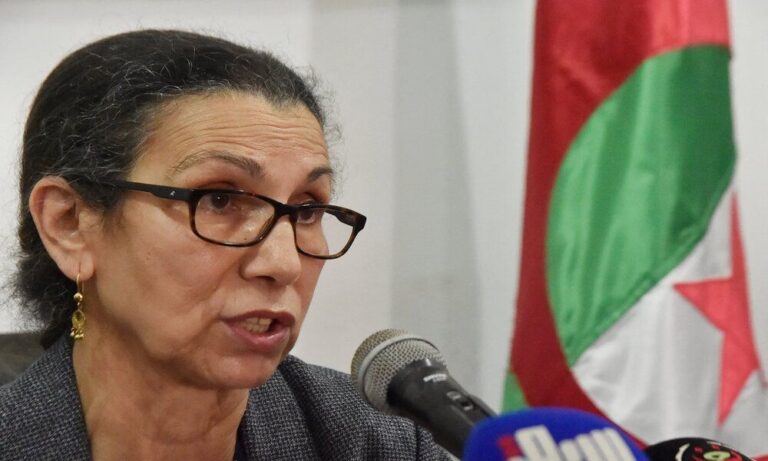
The Workers’ Party (PT), led by Louisa Hanoune, is going through difficult times following its poor
showing in the July 2 parliamentary elections and the filing of a defamation lawsuit against its secretary general.
These developments are occurring within the context of a realignment of the Algerian political opposition.
The secretary general of the Workers’ Party (PT), Louisa Hanoune, is facing a new and delicate situation on both the political and legal fronts. Just days after the July 2 parliamentary elections, in which her party won only three seats in the National People’s Assembly (APN), the left-wing leader is the target of a defamation lawsuit filed by a member of the government, according to press reports.
This legal action comes after public statements made by Louisa Hanoune during a press conference.
While the details of the alleged remarks have not been officially specified, this case has thrust the former presidential candidate back into the spotlight of the legal world, several years after her 2019 imprisonment on charges of conspiracy against the state, before her acquittal on appeal.
On the political front, the July 2nd legislative elections marked a further setback for the Workers’ Party (PT). With only three seats, the PT’s parliamentary representation remains marginal in an Assembly largely dominated by the National Liberation Front (FLN), which won the most seats with 90, in an election marked by an official turnout of 21.24%, the lowest ever recorded in Algerian legislative elections.
Long considered one of the leading figures of the left-wing opposition in Algeria, Louisa Hanoune now operates in a political landscape profoundly transformed since the Hirak protest movement in 2019.
Despite occasional speculation suggesting a close relationship with President Abdelmadjid Tebboune, her party has failed to translate this perception into electoral momentum.
The combination of an electoral setback and a new legal battle illustrates the difficulties the Workers’ Party (PT) faces in regaining significant influence on the national political scene. In a
context of high abstention rates and a fragmented opposition, the PT will now have to try to maintain its institutional visibility with reduced parliamentary representation.
MK/AK/Sf/fss/as/APA