





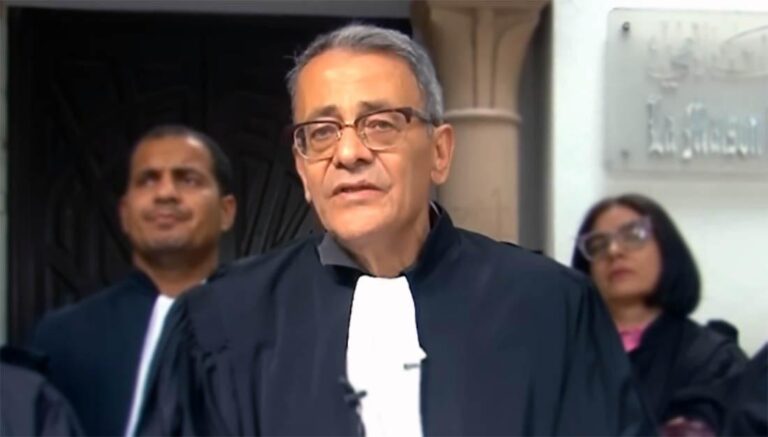
Ahmed Souab, a 68-year-old lawyer and former administrative judge, was sentenced on October 31, 2025, to five years in prison and three years of administrative supervision by the Tunis Court of First Instance.
Souab was convicted for publicly denouncing political interference in the judiciary, remarks he made last April shortly before his arrest. The trial lasted only a few minutes, following more than six months of pre-trial detention.
The hearing took place in the absence of the defendant, after the court ordered him to appear via videoconference, citing an unspecified “real danger.” Souab refused to participate, arguing that the procedure violated his right to a fair defense.
The former magistrate was charged under Tunisia’s anti-terrorism law with “forming and organising a terrorist conspiracy” and “spreading false information.” A video circulated on social media had shown him criticising the subservience of the judiciary to political pressure.
For his lawyers, the case represents a serious violation of freedom of expression. “His statements aimed to expose systemic abuses, not to threaten anyone,” said Me Samir Dilou, a member of Souab’s defense committee.
Another lawyer, Me Sami Ben Ghazi, described the proceedings as a “judicial farce,” noting that no pleadings or prosecution arguments were heard and that the verdict was delivered in the defendant’s absence.
In a statement issued on the eve of the ruling, Amnesty International condemned what it called a “mockery of justice”, accusing Tunisian authorities of using anti-terrorism legislation to silence peaceful dissent and instill fear. The NGO described the case as emblematic of “authoritarian practices” aimed at silencing lawyers, journalists, and human rights defenders.
Since President Kaïs Saïed’s power grab on July 25, 2021, Tunisia has witnessed a marked democratic backslide. The dissolution of Parliament and the Supreme Judicial Council paved the way for a wave of arrests targeting opposition figures, lawyers, and journalists, often on similar charges.
A respected public law scholar and former professor, Ahmed Souab was known for his advocacy of judicial independence. His rulings after the 2011 revolution helped strengthen civil liberties and curb administrative abuses.
His conviction has provoked strong reactions within Tunisia’s legal and academic circles. Boubaker Bethabet, head of the Tunisian Bar Association, denounced “the unacceptable nature of a closed-door trial conducted without due process.”
Souab’s defense committee condemned the verdict as “outrageous” and announced its intention to appeal the decision through all available legal means.
MK/te/sf/lb/as/APA