



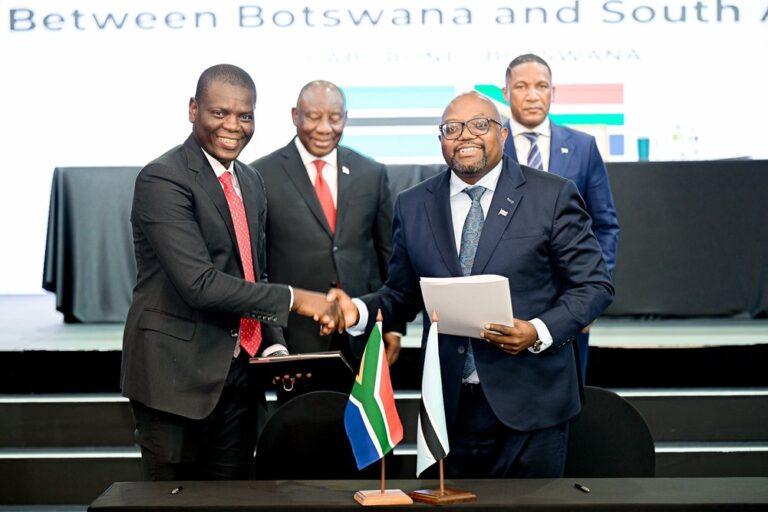
Botswana and South Africa have signed four cooperation agreements following the sixth Bi‑National Commission (BNC), deepening ties between the two neighbours across water management, aviation safety, energy and correctional services.
The agreements, concluded during President Cyril Ramaphosa’s visit to Botswana, cover the joint management of water quality and aquatic invasive species in the Upper Limpopo River Basin, coordination of aeronautical search‑and‑rescue services, collaboration in the energy sector and cooperation between correctional and prison services.
President Duma Boko said the BNC “remains a vital mechanism for advancing Botswana-South Africa relations and for translating political goodwill into practical cooperation,” describing it as a platform built on “mutual trust, sustained dialogue and shared purpose.”
Ramaphosa echoed the sentiment, saying bilateral relations “remain very strong” and that the new agreements “lay the basis for effective implementation in the months ahead.”
The latest commitments build on decades of close political, economic and security cooperation between the two neighbours.
South Africa is Botswana’s largest trading partner while hundreds of citizens of both countries cross the border daily for work, commerce and education.
The two governments also collaborate through regional structures such as the Southern African Development Community where they have jointly championed initiatives on industrialisation, energy security and cross‑border infrastructure.
The new agreement on water quality and aquatic invasive species reflects growing concern over environmental pressures in the Upper Limpopo River Basin, a shared resource critical to agriculture, mining and domestic supply.
The aeronautical search‑and‑rescue pact is expected to strengthen joint responses to aviation emergencies across shared airspace, while the energy cooperation agreement aims to support long‑term regional power stability.
The correctional‑services accord will facilitate information‑sharing, training and coordinated approaches to rehabilitation and prison management.
Both leaders said the agreements signal a renewed commitment to structured, results‑oriented cooperation.
Implementation work is expected to begin immediately through technical teams from both governments.
JN/APA