





African leaders attending the African Development Bank Group’s 2026 Annual Meetings in Brazzaville on Monday marked Africa Day with the host, President Denis Sassou-Nguesso, announcing that the Republic of the Congo would waive visa requirements for all African nationals from next year.
The announcement, marking another significant step towards continental integration, drew prolonged applause from thousands of delegates attending the meetings taking place at the Kintele Conference Centre.
“As from the first of January 2027, nationals of all African countries will have visa-free access and will no longer need a visa to come to Congo,” he said, urging countries to move beyond “selfishness and nationalism” and deepen regional integration through practical implementation of the African Continental Free Trade Area.
The commemoration brought together African heads of state and government, ministers, diplomats, investors, development partners, civil society representatives, youth leaders, and private-sector stakeholders united around Africa’s regional integration and transformation agenda.
Observed annually on 25 May, Africa Day commemorates the founding of the Organisation of African Unity in Addis Ababa in 1963, which later evolved into the African Union.
This year’s celebration is aligned with the African Union’s 2026 theme, “Assuring Sustainable Water Availability and Safe Sanitation Systems to Achieve the Goals of Agenda 2063.”
President Sassou-Nguesso called for increased investments to ensure sustainable development, and accelerated action to improve water security and access to sanitation across Africa.
The Congolese leader stressed that no African state could independently finance the infrastructure needed to transform the continent, highlighting the need for collective investment in roads, railways, airports, ports, and energy systems.
President Sassou-Nguesso also renewed calls for global mobilisation around ecosystem restoration and reforestation, describing Africa’s forests as “a second green lung of humanity” and underscoring the continent’s role in addressing climate change.
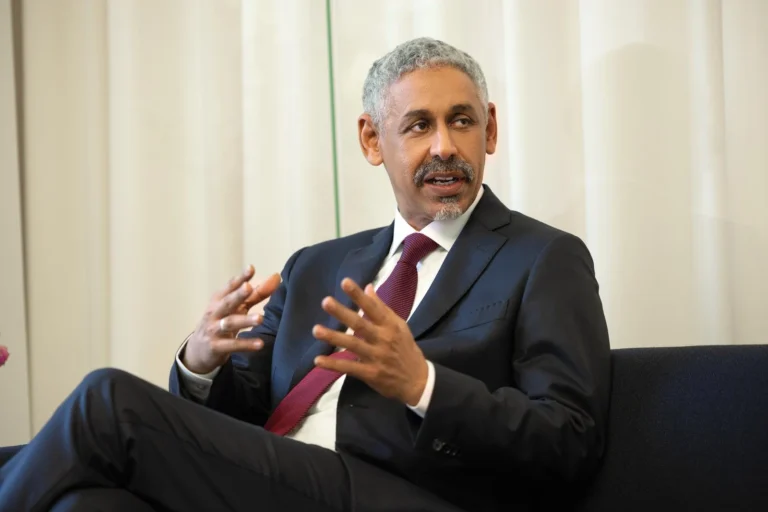
In his statement, the President of the African Development Bank Group, Dr Sidi Ould Tah, stressed the need for deeper continental integration, stronger African institutions, and renewed confidence in Africa’s ability to shape its own future amid mounting global uncertainty.
Describing Africa Day as “a dialogue of peace, solidarity and resilience,” Dr Ould Tah reiterated that Africa’s future depended on transforming its abundant natural resources into drivers of dignity and prosperity.
“Too often Africa is described in terms of what it lacks,” he said. “But if we focus only on what Africa does not have, we fail to see what it already possesses.”
He said Africa must strengthen its “collective agency” through deeper regional integration, stronger continental institutions, and a new African financing architecture capable of supporting long-term development ambitions.
“The generation of 1963 gave us political agency,” Ould Tah said. “Our responsibility now is to strengthen Africa’s collective agency through deeper integration, stronger institutions, and inward confidence in our ability to build our future together.”
In remarks delivered via video link, the African Union Chairperson and President of Burundi, Évariste Ndayishimiye, called for greater African solidarity, accelerated continental integration, and reforms to global governance systems to better reflect Africa’s growing role in world affairs.
Representing the Chairperson of the African Union Commission, Selma Malika Haddadi, Deputy Chairperson of the Commission said the celebration of Africa Day provided an opportunity to pay tribute to the African Development Bank Group for its critical role as the continent’s premier development financier.
“For decades, the African Development Bank has demonstrated that an Africa that invests in itself is an Africa that strengthens its economic sovereignty, its resilience, and its ability to take control of its own development,” she stated.
The programme, moderated by veteran Cameroonian journalist Denise Epoté, also showcased the grandeur of African art and culture brought to life by Congolese dancers and the evocative poetic recitations of Mariusca and Maître Muleck.
The 2026 Annual Meetings of the African Development Bank Group are being held in Brazzaville under the theme “Mobilising Africa’s Development Financing at Scale in a Fragmented World.”
Distributed by APO Group on behalf of African Development Bank Group (AfDB).
Africa’s growth holds firm amid global turbulence, says 2026 African Economic Outlook
BRAZZAVILLE, Republic of the Congo, May 28, 2026/ – 
Africa recorded an estimated average GDP growth of 4.4 percent in 2025, with 22 economies posting rates above 5 per cent.
In 2026, Africa is projected to grow at 4.2 per cent, despite heightened geopolitical tensions and global supply shocks.
Central Africa is expected to see growth rising to 3.8 per cent in 2026 from 3.6 per cent in 2025, buoyed by sustained high oil prices
Africa’s economies are projected to grow at 4.2 per cent in 2026, moderating slightly from 4.4 per cent in 2025, before rebounding to 4.4 per cent in 2027. The findings of the 2026 African Economic Outlook, released Tuesday at the African Development Bank Group Annual Meetings in Brazzaville underscore the continent’s continued resilience in the face of geopolitical tensions, tighter global financial conditions, and supply chain disruptions.
According to the Bank’s flagship report, Africa’s growth in 2025 was supported by improved macroeconomic management, stronger agricultural output, elevated commodity prices, and ongoing structural reforms.
The continent remains among the world’s fastest-growing regions, with 22 countries projected to grow above 5 per cent in 2025.
Published under the theme, Mobilizing Africa’s Development Financing at Scale in a Fragmented World, the report notes that sustaining faster, inclusive and more resilient growth would require a decisive shift towards mobilising and deploying capital at scale.
This includes strengthening domestic resource mobilisation, deepening and integrating financial systems, expanding capital markets, and enhancing African agency in global finance.
East Africa is expected to remain the continent’s fastest-growing region, though growth is projected to ease from 6.6 percent in 2025 to 5.9 per cent in 2026, as rising energy and import costs linked to Middle East disruptions take their toll. A rebound to 6.4 per cent is anticipated in 2027.
West Africa is forecast to remain relatively stable, with growth projected at 4.7 per cent in 2026, broadly in line with the estimated 4.8 per cent for 2025, supported by strong agricultural production and continued infrastructure investment.
North Africa is expected to grow at 4.0 per cent in 2026 compared to 4.4 per cent in 2025, reflecting weaker tourism demand from Gulf states, and the broader effects of global supply chain disruptions.
Central Africa is one of the few regions projected to see an uptick, with growth rising marginally to 3.8 per cent in 2026 from 3.6 per cent in 2025, buoyed by sustained high oil prices.
Growth in Southern Africa is expected to remain subdued at 2.1 per cent in 2026, from 2.3 per cent in 2025, weighed down by weaker mining and agricultural output and higher energy costs.
Downside risks to the outlook remain significant. Inflation is projected to stay elevated at 10.4 per cent in 2026, posing continued challenges to macroeconomic stability and growth prospects.
Persistent geopolitical tensions, alongside prolonged global supply chain and energy disruptions, could further strain fiscal and external balances through higher energy and fertilizer prices.
In addition, financial market volatility and exchange rate depreciations risk amplifying debt and fiscal vulnerabilities, while rising global fragmentation may intensify pressures on external financing flows, including official development assistance.
At the heart of the 2026 AEO report is a stark assessment of Africa’s development financing shortfall: the continent faces an annual gap exceeding $1.3 trillion to meet the Sustainable Development Goals.
The African Development Bank attributes the deficit to low domestic resource mobilisation, weak financial intermediation and tightening external financing conditions.
However, it argues, the issue is not only about a lack of resources but also about effectively deploying capital.
With appropriate reforms, Africa could unlock up to $1.43 trillion annually through improved revenue collection, more efficient public investment, staunching illicit financial flows and corruption, deeper capital markets, expanded public-private partnerships, diaspora financing, and better use of natural capital.
Among the key opportunities identified are an estimated $469 billion in additional annual revenues from stronger tax and non-tax mobilisation, alongside roughly $299 billion in potential savings from improved public investment efficiency.
Public-private partnerships are highlighted as a powerful lever, with each additional dollar of public investment associated with approximately $1.40 in private investment.
Institutional investors, including pension funds, insurers and sovereign wealth funds, manage around $4 trillion in assets; yet less than 2.7 per cent is allocated to infrastructure and productive sectors in Africa, underscoring significant untapped potential.
The report calls for accelerated efforts to strengthen Africa’s financial systems through pan-African banks, integrated capital markets, and innovative instruments such as climate and Islamic finance. A central pillar to this is the New African Financial Architecture for Development (NAFAD), which aims to leverage over $4 trillion in assets within Africa’s financial ecosystem.
The report also highlights the role of the African Credit Rating Agency, launched in January 2026, as an important tool for addressing perceived biases in sovereign risk assessments. While Africa’s stock market capitalisation reached $1.2 trillion in 2024 — nearly sixfold growth over two decades — activity remains concentrated in South Africa, Egypt, Nigeria, and Morocco, pointing to the need for broader market integration.
The report, distributed by the APO Group on behalf of African Development Bank Group (AfDB), further underscores the importance of advancing continental initiatives, such as the African Financing Stability Mechanism, to ease liquidity pressures, strengthen financial stability, and help African countries manage debt refinancing risks at lower cost.
GIK/APA