





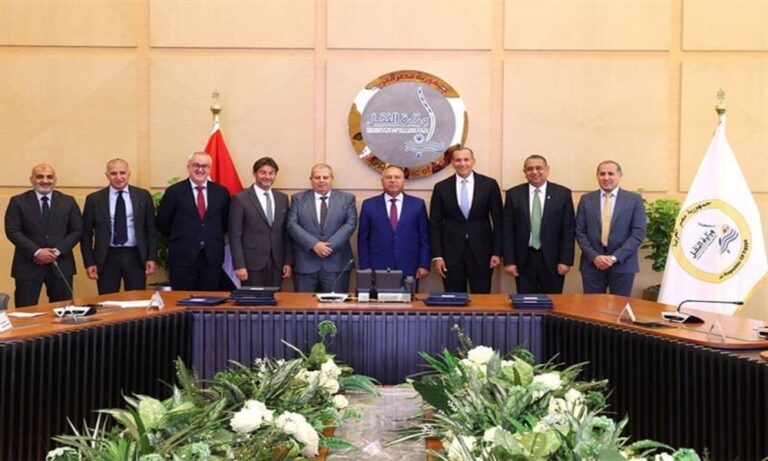
Cairo is accelerating the renovation of its logistics network with the signing of rail contracts worth approximately €690 million, designed to more efficiently connect industrial, agricultural, and mining zones to seaports and new urban centers.
On June 18, the Egyptian National Railways Authority (ENR) concluded a series of contracts totaling around €690 million with a consortium comprising Alstom, Rowad Modern Engineering, and Concrete Plus. According to the Egyptian Ministry of Transport, these investments are part of the national strategy to modernize railway infrastructure, enhance safety, and increase freight transport capacity.
Beyond network upgrading, the Egyptian government is pursuing a broader objective to transform rail into the backbone of its national logistics system. Transport Minister Kamel Al-Wazir stated that these projects contribute to the implementation of several logistics corridors designed to connect major industrial, agricultural, and mining production hubs to seaports and new cities developed as part of major regional development programs.
The bulk of the investment is focused on the strategic 6 October–Alexandria corridor, with a total cost of approximately €550 million. According to Alstom, the project includes the installation of next-generation digital rail systems, the modernization of telecommunications, the reinforcement of electrical equipment, and the rehabilitation of rail and civil infrastructure. The stated objective is to improve safety, increase network capacity, and reduce travel times by approximately 80 minutes along the entire route. This specific corridor comprises three major projects. The first involves the 137-kilometre Al-Maraziq–6 October line, featuring the modernization of signalling systems and the creation of a new rail link. The second project concerns the Bachtil–Itay El-Baroud line, where the track will be doubled and the signalling equipment modernized. Finally, the Al-Ittihad–Al-Qabbari line will also undergo a complete renovation of its control and safety systems.
The second component of the program concerns the new 63-kilometer Robeiki–10 Ramadan–Belbes (B10) line, representing an estimated investment of approximately €140 million. This infrastructure is intended to strengthen connections with the industrial city of 10 Ramadan, considered one of the main manufacturing hubs in Egypt and the Middle East. According to Alstom, the project aims to improve the efficiency of freight transport and support the development of the Eastern Logistics Corridor.
These investments illustrate the Egyptian government’s commitment to repositioning rail at the heart of its competitiveness strategy. By improving connections between production areas, export ports, and major logistics corridors, Cairo aims to reduce transportation costs, streamline supply chains, and enhance the country’s industrial appeal. Furthermore, the integration of this infrastructure into the Sokhna–Alexandria logistics corridor, which combines seaports, a dry port, a conventional rail network, and a high-speed electric rail, reflects Egypt’s ambition to build a multimodal transportation system capable of supporting the growth of domestic industry and foreign trade in the coming years.
MK/AK/Sf/fss/abj/APA