



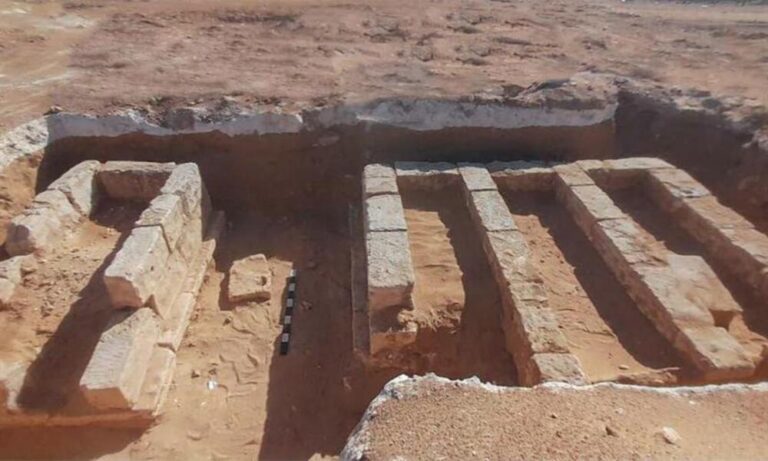
Egypt’s Ministry of Tourism and Antiquities has announced two major archaeological breakthroughs, revealing a series of nearly 2,000-year-old tombs along the Mediterranean coast alongside the well-preserved remains of a 4th-century Byzantine-era settlement deep in the Western Desert.
The coastal discovery occurred at Marina El-Alamein, located about 100 kilometers west of Alexandria, a site corresponding to the ancient Greco-Roman port city of Leukaspis. Researchers uncovered 18 ancient tombs—including 11 deep rock-cut burial chambers and seven limestone surface tombs—several of which featured original stone blocking slabs that had kept them sealed for two millennia. Inside, archaeologists found human skeletal remains alongside pottery, oil lamps, altars, and amphorae. Among the most remarkable finds was an intact 2.5-meter granite sarcophagus and 24 gold funerary objects placed inside the mouths of the deceased, a “golden tongue” ritual tied to ancient beliefs regarding protection and the journey into the afterlife. These additions bring the total number of recorded tombs at the site to 48 since its initial discovery in 1986.
Concurrently, deep within the Dakhla Oasis of the Western Desert, an archaeological team exposed an entire 4th-century Byzantine village at Ain al-Sabil. Built completely from mudbrick, the highly structured settlement features a pre-planned grid layout of north-south thoroughfares, east-west streets, open public squares, residential homes, defensive fortifications, and a central basilica-style church. The desert site yielded an unusually vivid glimpse into Late Antiquity daily life, producing bronze and gold coins—some from the reign of Roman Emperor Constantius II—and around 200 ostraca, which are pottery fragments inscribed with Coptic and Greek writing.
Egyptian authorities are highlighting these parallel discoveries as part of an ongoing strategy to safeguard the nation’s diverse cultural heritage while creating new historical destinations to boost international tourism. The sector serves as a vital economic engine for Egypt, generating critical foreign currency alongside Suez Canal revenues and overseas worker remittances.
AK/Sf/lb/abj/APA