





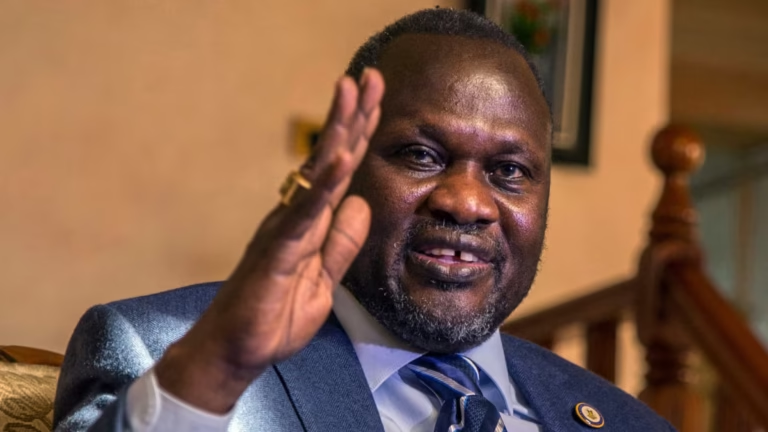
The South Sudanese capital Juba is at a standstill on Monday as former vice president Riek Machar is whisked to court charged with treason.
Machar has been in detention since March and is charged with being the lead orchestrator of violence in Upper Nile State which led to the killing of over 20 security officers at an army base. His supporters in the opposition have dismissed the allegation, saying he is the victim of a witch hunt by his old rival President Salva Kiir.
They warned that the situation surrounding his detention and prosecution could be a recipe for more instability in the world’s newest independent country.
Streets in downtown Juba have been virtually empty of traffic on Monday morning as thousands fearing an outbreak of unrest stayed at home to follow the politically charged trial in the so-called Freedom Hall of Mr Machar, who has been part of a shaky unity government led by President Kiir since 2018.
The two eventually fell out in March this year as Machar, his wife and some of his bodyguards were rounded up over deadly unrest in Upper Nile State and detained despite repeated calls for their release by the opposition and South Sudan’s international partners.
In anticipation of trouble, more troops from neighbouring Uganda have been deployed in and around Juba to secure members of the government and state institutions.
Writing on the website of Radio Tamazuj, political commentator Samuel Peter Oyay, described the trial of Mr Machar as a charade to eliminate any form of opposition to President Kiir whether armed or political.
”His rule depends not on unity but on mistrust, scapegoating, and the careful balancing of elites whose authority never exceeds his own” Oyay said.
”On the surface, the trial appears to represent accountability—a long-awaited legal reckoning after decades of war and rebellion. In reality, it functions as a new instrument of governance and control. By keeping Machar under the perpetual shadow of prosecution, Kiir neutralizes his ability to mobilize supporters or present himself as an alternative center of power”.
According to the political thinker, the trial may never reach a definitive conclusion but could drag on, ”suspended between adjournments, symbolic hearings, and indefinite delays…a legal limbo which means that Machar is never fully convicted but also never free.
”He becomes a captive figure in a theatre of governance, humiliated publicly yet preserved as a warning to others who might imagine challenging the regime” Oyay added.
Despite riches in oil South Sudan remains one of the poorest countries in Africa, where civil war broke out in December 2013, just two years after the country gained independence from Sudan.
Since then several peace accords had been reached and broken before a deal was reached in 2018 to set up a government of national unity led by President Kiir with Machar as first vice-president.
WN/as/APA