





The chair of the European Parliament’s Subcommittee on Human Rights (DROI) has called on the European Union to impose sanctions against Tunisian President Kais Saied, arguing that the deteriorating human rights situation in Tunisia can no longer go unnoticed.
In an opinion piece published on Tuesday, the MEP responsible for the DROI denounced an intensification of repression in Tunisia, targeting, according to him, civil society activists, lawyers, journalists, and human rights defenders.
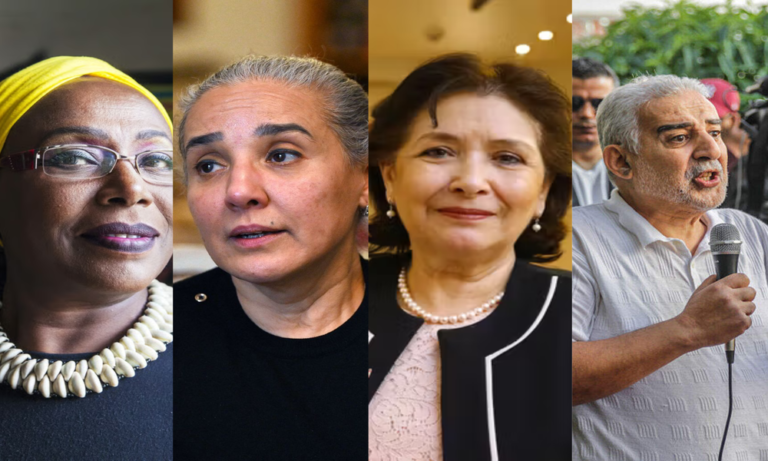
He specifically cited the appeal conviction of anti-racism activist Saadia Mosbah to eight years in prison, the initial 25-year prison sentence handed down to human rights activist Sihem Bensedrine, and the confirmation of the one-year prison sentence against journalist Zied El Heni.
The author also mentions the convictions of journalists Mourad Zeghidi and Borhen Bsaies, as well
as the national strike held by Tunisian lawyers on June 18 to protest the functioning of the justice system.
According to the MEP, Tunisia has experienced a continuous deterioration of the rule of law since Kaïs Saïed came to power in 2019, and particularly since the exceptional measures taken in July 2021, which led to a profound reconfiguration of institutions.
He believes that the prosecutions of political opponents, lawyers, journalists, and leaders of civil society organizations reflect a growing restriction of public freedoms.
The opinion piece also criticizes the European Union’s policy toward Tunis. Its author accuses the European Commission of continuing its cooperation with the Tunisian authorities, particularly within the framework of the “comprehensive strategic partnership” concluded in 2023 on migration issues, without making this cooperation conditional on progress in the area of fundamental rights.
He recalls that the European Parliament adopted a resolution in November 2025 calling for the release of lawyer Sonia Dahmani, while regretting that she was subsequently convicted again.
The MEP also indicates that a mission by the subcommittee on human rights law (DROI) planned for Tunisia last April could not take place after the Tunisian authorities refused to grant it permission.
He further emphasises that several European lawyers recently asked the High Representative of the Union for Foreign Affairs and Security Policy, Kaja Kallas, to consider targeted sanctions against Kaïs Saïed under the European Union’s global human rights sanctions regime, established in 2020.
At this stage, the Tunisian authorities have not publicly reacted to these new statements. They have repeatedly stated that the legal proceedings initiated in the country fall within the independence of the judiciary, and rejected foreign criticism, which they consider interference in Tunisia’s internal affairs.
MK/AK/Sf/fss/as/APA