





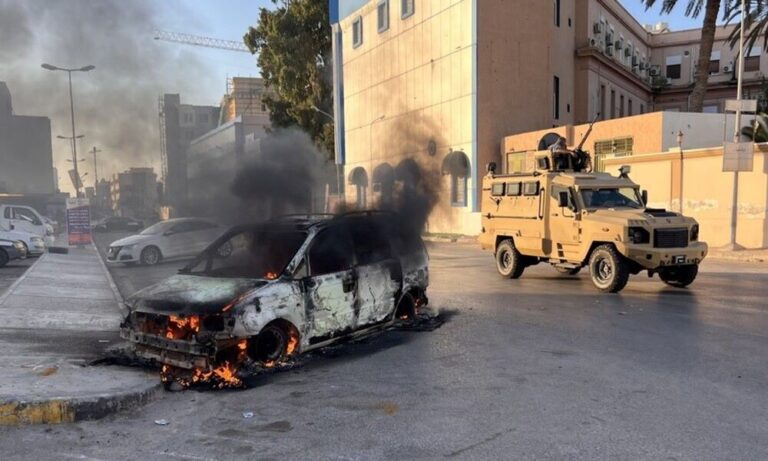
Clashes between armed groups has led to the closure of a strategic road leading to the Al-Zawiya refinery, in western Libya as security continues to deteriorate.
Armed clashes broke out on Monday in several neighbourhoods of the town of Al-Zawiya, about forty kilometres west of Tripoli, causing the closure of the road leading to the oil refinery, according to local sources.
No official authority had immediately communicated the human or material toll or specified the circumstances of the outbreak of violence.
According to local sources, the fighting took place between armed groups in several sectors of the city.
The clashes led to the closure of the access road to the coastal road, known locally as the “refinery
road”, which notably connects the Al-Fassi area. This axis is considered strategic because of its role in access to the Al-Zawiya refinery, one of the main oil infrastructures in western Libya.
The authorities did not specify the causes of the clashes or identify the groups involved. No official casualty or material damage report was available at the time of publication.
These new incidents come two days after another episode of violence in the same city.
Four people were killed when their vehicle was targeted by armed men near Al-Zawiya University, before bursting into flames as a result of gunfire.
According to the National Institute for Human Rights in Libya, the attackers were armed individuals described as “outlaws”.
The organisation indicated that it had documented the facts while emphasising that no element made it possible, at this stage, to establish a link between this attack and the clashes that occurred on Monday.
In a press release, the institute called on the attorney general and the security services to open a thorough investigation in order to identify and arrest those responsible.
He also expressed his concern about the increase in extrajudicial executions, kidnappings and
arbitrary arrests in Libya, believing that this development reflects the continued deterioration of the security situation and the difficulties of the security forces in ensuring the protection of civilian populations.
MK/AK/Sf/fss/as/APA