





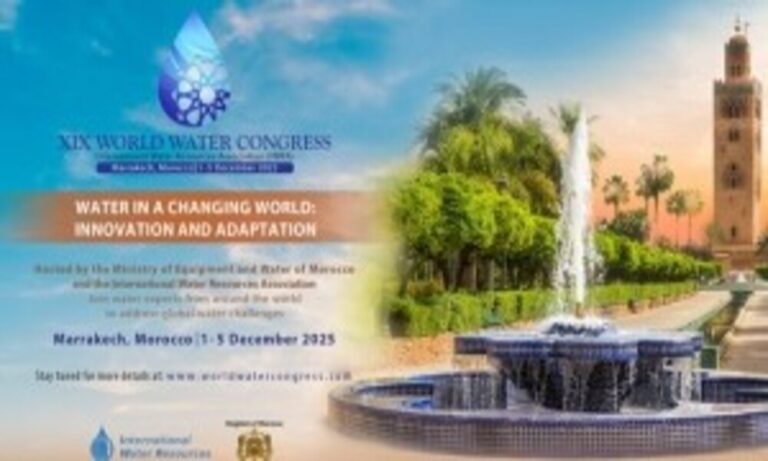
The 19th edition of the World Water Congress, held under the theme “Water in a Changing World: Innovation and Adaptation,” kicked off in Marrakech on Monday.
The congress comes against a global context marked by the climate emergency, resource scarcity, and increasing environmental pressures.
Co-organised until December 5 by the Ministry of Equipment and Water and the International Water Resources Association (IWRA), the event is an opportunity to explore innovative solutions, strategies, and adaptive approaches for water resources in an ever-changing world.
The congress will offer a platform for experts, practitioners, researchers, policymakers, civil society, and the private sector to exchange knowledge, present innovative research, forge partnerships, and jointly develop concrete solutions aimed at addressing the complex challenges of global water governance, security, and sustainability.
It is also a venue to promote collaboration among governments, academia, civil society, and the private sector, and to highlight Morocco’s expertise in water resource management, particularly in arid environments, desalination, and non-conventional water resources.
In an address delivered at the opening, Moroccan Minister of Equipment and Water, Nizar Baraka, stressed that the country’s water system combines seawater desalination, dams, wastewater reuse, groundwater recharge, digitisation, and regional water contracts.
He added that Morocco has embarked on a new approach for managing its water resources, based on adopting integrated development master plans for all hydraulic basins by the year 2050. The minister specified that these master plans form the basis for drafting the National Water Plan, which represents a national roadmap aimed at ensuring convergence among the state, regions, territorial communities, and economic actors.
He reported that 17 desalination plants have been completed, with a production capacity reaching 350.3 million cubic meters per year, while four other projects are currently under construction for a capacity of 567 million cubic meters.
In addition, 11 projects are planned for drinking water supply, irrigation, and industrial use, targeting a total capacity of 1.7 billion cubic meters by 2030, with operation based on renewable energy to ensure sustainability, he indicated. He underlined that Morocco is moving towards a “water – energy – food” nexus model, which links these three sectors in a unified policy and common vision, with tangible benefits for the lives of citizens.
The programme for the 19th edition includes a Ministerial Roundtable, four High-Level Panels, over 140 technical sessions led by international experts, parallel events to delve into specialised topics, and a vast exhibition area dedicated to showcasing innovative water technologies and projects.
The congress will culminate in the Marrakech Declaration, a collective appeal uniting policymakers, scientists, and practitioners to strengthen the link between science, policy, and action and accelerate global mobilisation for water preservation.
AK/sf/lb/as/APA