



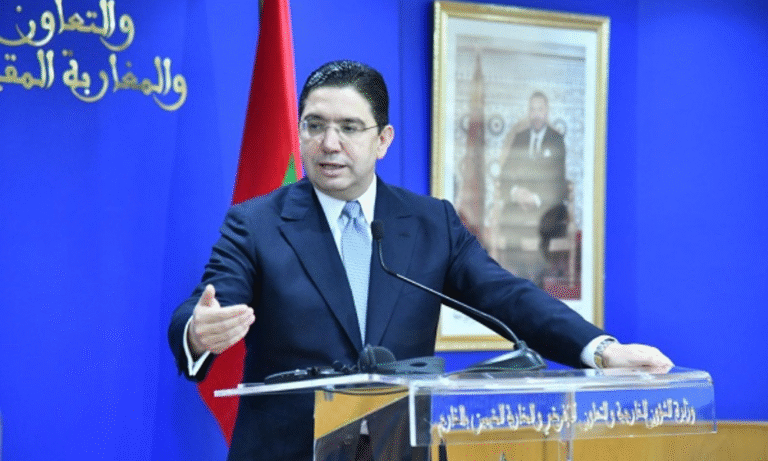
Moroccan Foreign Minister Nasser Bourita has stressed that King Mohammed VI’s maritime strategy places the ocean at the center of economic development, continental influence, and the defense of sovereignty, through a series of regional and international initiatives.
Speaking at the opening of an international seminar on the delimitation of maritime spaces, held in partnership with the Institute of International Law, Bourita emphasised that the Royal Vision links territorial integrity with Morocco’s emergence as a major maritime actor. For him, the sea is conceived as “a space of economic and human communion,” particularly with Africa, rather than a mere boundary.
This vision has materialised in the consolidation of the “blue economy” and the development of flagship port infrastructure such as Tanger-Med — now one of the Mediterranean and Africa’s main hubs — and the future Dakhla Atlantic port, designed to strengthen economic integration with the continent. Bourita also referred to the kingdom’s ambition to rebuild a competitive national merchant fleet capable of ensuring seamless connections with Africa and beyond.
Internationally, Rabat has made the ocean a cornerstone of its diplomacy by embedding the maritime dimension into key strategic initiatives. The Rabat Process, launched in 2022, brings together 23 Atlantic African countries around shared objectives: enhancing maritime security, protecting the environment, and promoting the blue economy. In 2023, Morocco unveiled the Royal Initiative to provide Sahel countries with access to the Atlantic, offering landlocked states logistical corridors through its port infrastructure. Meanwhile, the Nigeria–Morocco gas pipeline, launched in 2016, is set to cross 13 African countries, spur local infrastructure, and drive regional industrialisation while consolidating the continent’s energy security.
“These initiatives embody a constant truth: in Africa, everything becomes possible when a strong vision is coupled with firm resolve,” Bourita said.
Morocco is also advocating for an update of the international legal framework. While the 1982 Montego Bay Convention on the Law of the Sea remains a landmark text, Rabat argues it is no longer adequate to address emerging challenges. Morocco is calling for renewed governance that takes into account technological advances, biodiversity protection, and environmental concerns.
The minister welcomed the adoption of the High Seas Biodiversity Agreement (BBNJ), describing it as a “historic instrument” and a “strategic and ethical urgency” for African economies whose prosperity directly depends on ocean health.
The Rabat seminar brought together jurists and international experts, including Mohamed Bennouna, President of the Institute of International Law, and Yuji Iwasawa, President of the International Court of Justice. Their presence underlined the global relevance of the Royal Vision, which positions Morocco as a key actor in shaping the law of the sea and global maritime governance.
MK/sf/lb/as/APA