



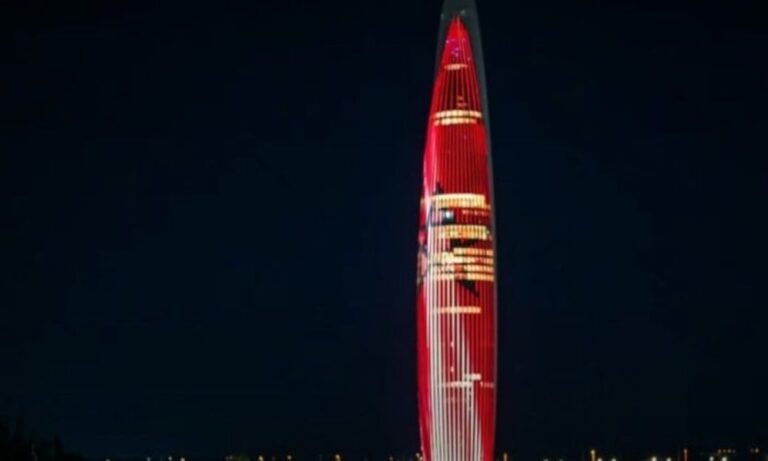
Now dominating the Rabat and Sale skyline, the Mohammed VI Tower is part of a new generation of African projects combining height, advanced engineering and enhanced environmental criteria.
The Mohammed VI Tower, Morocco’s tallest building at 250 metres, has obtained LEED Gold environmental certification thanks to the use of low-carbon concrete developed by the Swiss group Holcim, according to information released by the company.
Erected on the banks of the Bouregreg River in Rabat, the building reinforces the Kingdom’s position in the infrastructure sector, incorporating international environmental standards.
Designed by architects Rafael de La-Hoz and Hakim Benjelloun, the 55-story tower has gradually established itself as one of the most visible architectural landmarks of the Moroccan capital.
Holcim emphasises that the building’s silhouette, compared to “a rocket standing on its launch pad,” remains visible from up to 50 kilometres away.
The building houses a luxury hotel, high-end apartments, and a panoramic terrace at the top of the structure.
Beyond its symbolic significance, the project is based on technical choices related to the requirements of an area exposed to seismic risk.
The tower’s designers opted for high-strength concrete to ensure the structure’s stability despite its height and the site’s specific geological characteristics.
Holcim specifies that ECOPlanet low-carbon cement was integrated into the core of the load-bearing structure, with the aim of reducing construction-related emissions while
maintaining the required mechanical performance.
This LEED Gold certification comes amid a growing emphasis on environmental standards in premium real estate and major urban projects in Africa.
The LEED label, developed by the US Green Building Council, is one of the most widely used international benchmarks for assessing the environmental performance of buildings, particularly in terms of energy efficiency, materials management and
carbon footprint reduction.
Receiving this award also reinforces the strategy of cement groups to accelerate the development of materials with lower carbon dioxide emissions, given that the cement sector represents a significant share of global industrial emissions.
For several years, Holcim has been increasing its investments in low-carbon cement ranges intended for urban infrastructure and major real estate projects.
Through its architectural and technological positioning, the building contributes to the transformation of the Bouregreg corridor, which has become one of the Kingdom’s main urban development hubs.
MK/AK/Sf/fss/jn/APA