



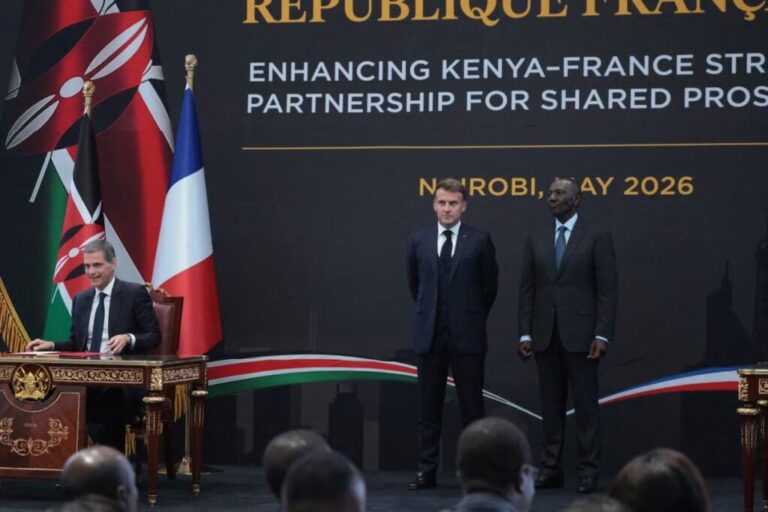
On the sidelines of the Africa Forward Summit in Nairobi, a strategic cooperation agreement was signed between the Kenyan government and the CMA CGM Group under the auspices of Presidents Emmanuel Macron and William Ruto.
During his visit to Nairobi, Macron announced on Sunday a €700 million investment in Kenya.
The agreement, concluded with the Kenyan authorities, notably includes the construction of a port terminal in Mombasa capable of accommodating larger container ships.
Founded in Marseille, CMA CGM has become, in just a few decades, one of the world’s leading shipping and logistics groups.
Already present in several African ports, the group is now strengthening its presence on the continent through a long-term strategy focused on port infrastructure, regional connectivity and the decarbonisation of supply chains.
The choice of Kenya is far from insignificant. As the leading economy in East Africa alongside Ethiopia, Nairobi has gradually established itself as a major trading hub connecting the Indian Ocean, Central Africa and the markets of the Gulf and Asia.
Through the ports of Mombasa and Lamu, Nairobi has been seeking for several years to consolidate its role as a regional hub capable of connecting trade flows from Uganda, Rwanda, South Sudan and the Democratic Republic of Congo.
In this context, the agreement signed with CMA CGM aims to explore several projects related to the development of the country’s port and logistics capacity.
The stated objective is clear: to strengthen the competitiveness of the East African corridor and support the growth of maritime and land trade in a region considered one of the most dynamic on the continent.
The figures reflect this gradual transformation. Between 2019 and 2025, trade in goods between France and Africa increased from €52 billion to €64 billion.
Above all, a growing share of French investment and trade now involves non-Francophone countries.
Nearly 45% of French direct investment stock in Africa is now directed towards these markets.
This diversification is particularly noticeable in East Africa and in several major logistics hubs across the continent.
In this new economic landscape, port infrastructure plays a strategic role. It not only facilitates trade but also secures supply chains that have become crucial in global competition.
It is within this geography of flows that CMA CGM intends to strengthen its position.
The group is currently involved in several major infrastructure projects on the continent: Lekki in Nigeria, Kribi in Cameroon, Pointe-Noire in Congo, Nador West Med in Morocco and Sokhna in Egypt.
In each case, the underlying principle remains the same: to develop platforms capable of more effectively connecting African markets to major global trade routes.
Ports, corridors, decarbonisation – the group is strengthening its African network.
Beyond ports, the group is also focusing on inland logistics integration through its subsidiary CEVA Logistics, developing corridors that combine maritime, road, and rail transport.
This has become crucial in regions where logistics costs remain among the highest in the world and where the smooth flow of trade remains a key factor in competitiveness.
Environmental considerations are also a central element of these projects. CMA CGM states its intention to accelerate the decarbonisation of African transport and logistics infrastructure.
In Nigeria, the group is working on a project for 100 percent electric river barges around the port of Lekki to reduce emissions related to urban freight transport.
The signing in Nairobi illustrates a broader shift: an economic diplomacy now centred on infrastructure, logistics, and trade flows.
AP/Sf/fss/jn/APA