



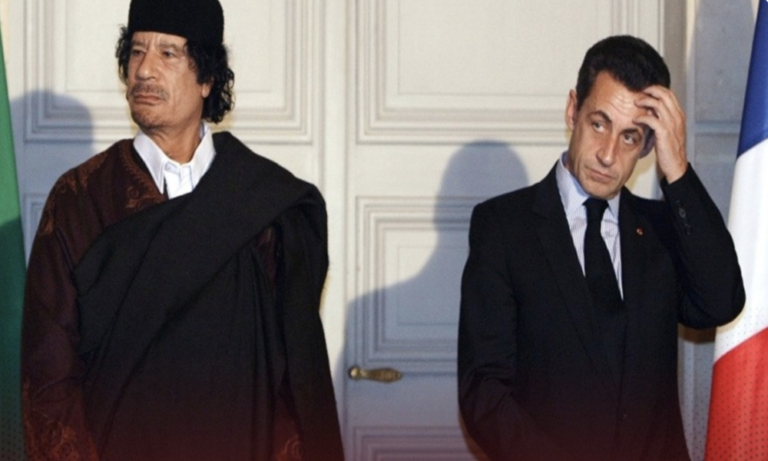
Tripoli is seeking €10 million in damages in the case of alleged Libyan financing of the 2007 French presidential campaign.
Legal pressure is mounting on former French President Nicolas Sarkozy in the case of alleged Libyan financing of his 2007 presidential campaign.
Before the Paris Court of Appeal, representatives of the Libyan state have claimed €10 million in damages from the former French head of state and five other defendants, arguing that Libyan public funds were misappropriated for the benefit of foreign political interests.
Lawyers representing Tripoli detailed their claims in two parts: €5 million for material damages and an additional €5 million for moral damages.
The plaintiffs maintain that the case transcends purely French political considerations and directly concerns resources belonging to the Libyan people during the era of Muammar Gaddafi.
According to Libyan representatives, the sums mentioned in the case stem from the illicit use of sovereign wealth funds to finance foreign political operations.
The dispute dates back to investigations opened in France into suspected illicit financial transfers that occurred in 2006.
French magistrates are particularly interested in the role played by the Franco-Lebanese intermediary Ziad Takieddine, accused of facilitating clandestine financial circuits intended to support Sarkozy’s presidential campaign.
For several years, this case has fuelled one of the most significant political and legal scandals of the French Fifth Republic.
Libyan lawyer Issam Al-Tajouri stated to several media outlets that Tripoli’s action was not a new complaint, but a reaffirmation of the civil actions already initiated by the Libyan state in this case.
He specified that the legal arguments were based on provisions of the French Penal Code and Code of Criminal Procedure relating to receiving funds from criminal activities, international corruption and influence peddling.
This new legal development comes as Sarkozy continues to contest all the accusations against him.
The former French president had already been sentenced in this case to five years in prison for “criminal conspiracy,” a decision he strongly contests.
His lawyers have denounced from the outset a procedure based on contradictory
testimonies and politically motivated accusations.
Beyond the French criminal aspect, this legal offensive also illustrates the Libyan authorities’ desire to reactivate several cases inherited from the Gaddafi era in order to recover assets and defend the state’s financial interests.
More than a decade after the fall of the Libyan regime, the Sarkozy affair thus remains at the crossroads of diplomatic tensions, French political rivalries, and financial disputes linked to the former Libyan power.
MK/AK/Sf/fss/jn/APA