





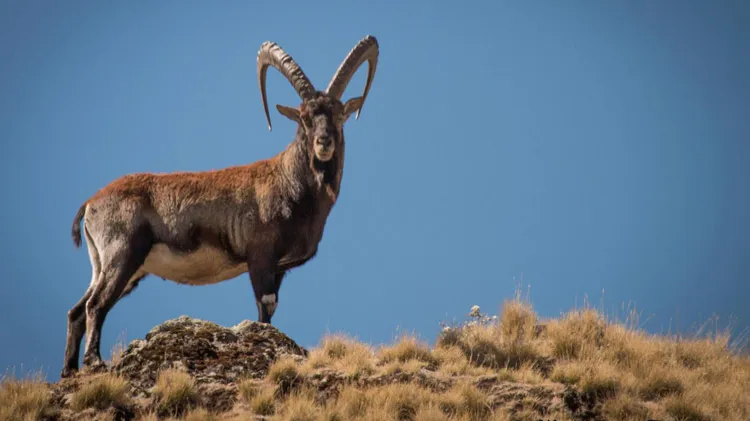
The population of Ethiopia’s Walia ibex, a rare wild goat endemic to the East African country, has increased to 306 now from 270 months ago following intensified conservation efforts in the Simien Mountains National Park in Amhara region, the Ethiopian Wildlife Conservation Authority (EWCA) announced on Monday.
Gebremeskel Gizaw, Director General of the National Parks Management Directorate attributed the increase in the Walia ibex population to combating poaching and raising awareness of the local community.
“Walia population has increased to 306 now from 270 in December last year due to coordinated national and international conservation efforts in the region,” Gizaw told reporters.
A month ago, the International Union for Conservation of Nature (IUCN) announced that the endemic animal was reclassified as critically endangered in 2026 after surveys and a recent study found the species had declined below a key population threshold.
According to IUCN, in December 2025, the number of Walia Ibex was recorded as 271 in Simien Mountains National Park in northern Ethiopia. Its entire global population is confined to this single protected area, making it one of the world’s most range-restricted large mammals.
EWCA said that a joint study conducted between the 2023 and 2025 fiscal years by the Authority, Simien Mountains National Park and the African Wildlife Foundation identified conflict in northern Ethiopia, habitat degradation, illegal hunting and other human pressures as major factors behind the decrease in Walia ibex population in Ethiopia.
The species’ Red List status has shifted several times as population estimates rose and fell. It was listed as endangered in 1986, critically endangered in 1996, endangered again in 2008 and then vulnerable after the 2020 assessment. Between 2009 and 2012, surveys had found the population increasing from 680 to 850 individuals, and researchers estimated it would exceed 975 by 2020. That optimism underpinned the vulnerable classification.
MG/gik/APA