





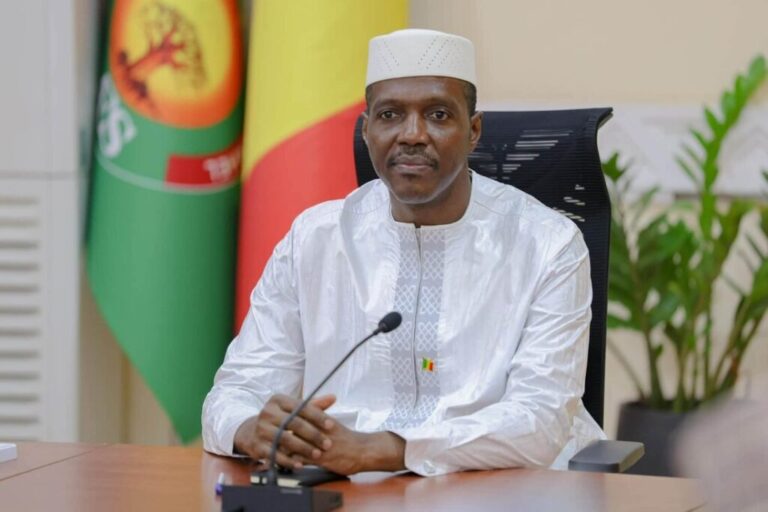
The Algerian Prime Minister Sifi Ghrieb has invited his Malian counterpart, Major General Abdoulaye Maiga, to pay a working visit to Algeria after several months of diplomatic tensions.
Prime Minister Ghrieb extended the invitation to his Malian counterpart for a working visit aimed at easing diplomatic tensions between the two countries on Sunday, August 9, 2026.
According to the statement from the Algerian Prime Minister’s office, the invitation was made during a phone conversation between the two heads of government, held on the instructions of Algerian President Abdelmadjid Tebboune,
During this exchange, Sifi Ghrieb and Abdoulaye Maiga reaffirmed their commitment to the fraternal, solidarity-based and good neighbourly relations between Mali and Algeria, as well as their desire to revitalize bilateral cooperation in several areas.
The two officials also discussed several regional and international issues and expressed their desire to contribute to making the Sahel a space for cooperation, exchange and shared development in a context marked by the search for greater security and stability.
The date of the Malian Prime Minister’s visit to Algiers has not yet been set and Malian official response to the invitation is still pending.
This initiative comes nearly a month after the first concrete signs of rapprochement between the two neighbours.
On July 10, Mali and Algeria announced the return of their respective ambassadors and the reciprocal reopening of their airspace to civilian and military aircraft operating flights to and from each other’s countries.
On August 7 in Bamako, Abdoulaye Maiga, in turn, emphasized his country’s commitment to maintaining dialogue with Algiers, assuring that there was “no diplomatic breakdown” between the two states, which share over 1,300 kilometres of border.
The Malian Prime Minister also reported a “complete convergence of views” between the President of the Malian Transition, Assimi Goita and his Algerian counterpart, Abdelmadjid Tebboune, particularly on issues of state sovereignty and non-interference.
This rapprochement comes after a period of high tension, notably linked to Mali’s withdrawal in January 2024 from the Agreement for Peace and Reconciliation in Mali, which stemmed from the Algeria’s process.
At the time, Malian authorities accused Algeria of being too close to certain armed groups operating in northern Mali. But Algeria rejected these accusations and denied any support for these groups.
The crisis reached its peak on the night of March 31 to April 1, 2025, following the downing of a Malian military drone near Tin Zaouatine.
Algeria had claimed that the aircraft had penetrated two kilometres into its airspace, while Mali maintained that it was over Malian territory and that its wreckage had been found 9.5 kilometres south of the border.
This incident led to the recall of ambassadors and the reciprocal closure of airspace. Mali subsequently announced its intention to refer the matter to the International Court of Justice, a move contested by Algeria.
However, recent statements announcing the resumption of dialogue did not specify whether these disputes were directly addressed or resolved.
The invitation extended to Abdoulaye Maiga nevertheless constitutes a further step toward the normalisation of relations and could pave the way for high-level political discussions on the remaining outstanding issues.
MD/te/Sf/fss/gik/APA