



Senegal aims to leverage space science as a driver for sovereignty, security, and economic development through projects involving astronomical infrastructure, satellite assembly, and the monitoring of its national territory, according to Maram Kaire, Director General of the Senegalese Space Studies Agency (ASES).
This strategy aligns with President Bassirou Diomaye Faye’s vision of transforming Senegal into a “space nation” by integrating satellite technologies into public policy – specifically in sectors such as agriculture, fisheries, flood prevention, land-use planning, and security.
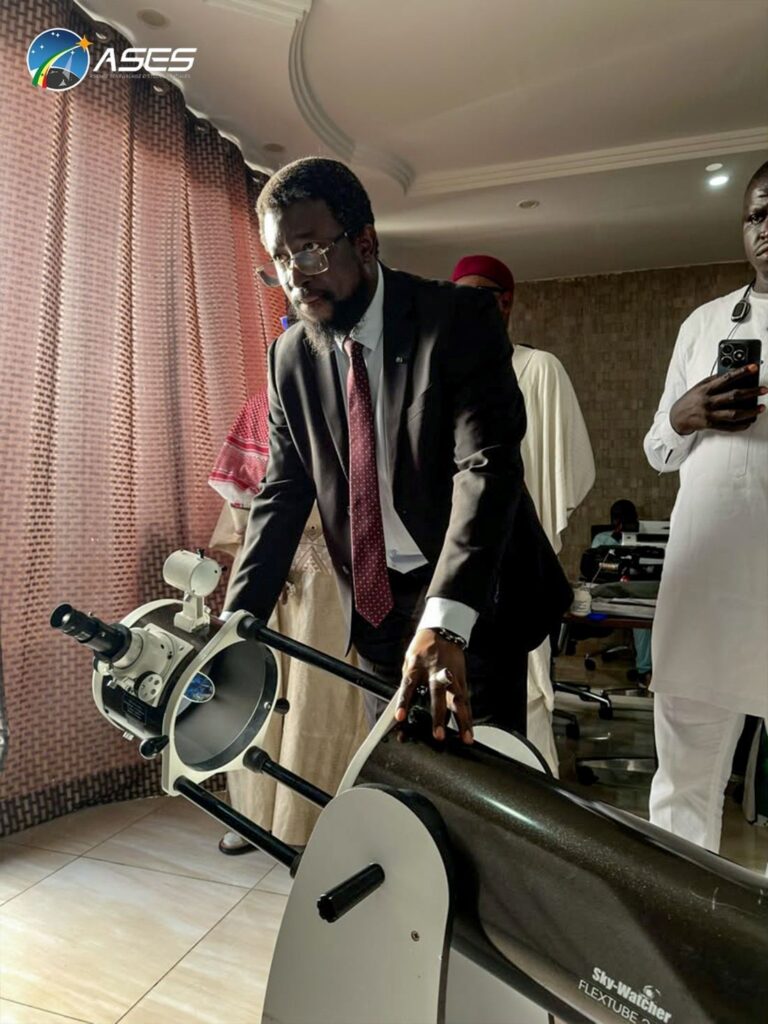
Speaking on the sidelines of a workshop on space science – aimed at media professionals and religious leaders and held from October 26 to 28, 2026, in Toubab Dialaw, in the west of the country – Mr. Kaire emphasised the need to clearly communicate the tangible benefits of these technologies to ensure they are embraced by the general public.
“It was important for us to ensure that not only do the media understand what we mean when we talk about space science, but that society as a whole also takes ownership of our space development project,” he explained, stressing the need to turn this ambition into a national endeavor that extends well beyond the Space Agency itself.
According to the ASES Director General, space technologies can provide solutions to a range of development challenges. Satellite data, for instance, can improve flood prevention, land management, smart agriculture, spatial planning, and the monitoring of forest resources.
Furthermore, these technologies can contribute to the advancement of telemedicine and the more effective management of urban mobility.
In the maritime sector – a significant pillar of the Senegalese economy – satellite surveillance serves as a strategic tool for protecting fisheries resources, combating illicit activities, and securing offshore oil installations.
Mr. Kaïré emphasised that a lack of appropriate surveillance capabilities would leave economic
activities and the marine environment increasingly vulnerable to risks.
“In the future, the use of space technologies to drive prosperity should be embedded in the very DNA of our economy,” he stated, advocating for the gradual integration of these tools across
productive sectors.
Regarding infrastructure, the ASES (Senegalese Agency for Space Studies) is focusing on several key foundational projects. The first involves the construction of a research observatory for astronomy and astrophysics – set to become the largest of its kind in West Africa – alongside the establishment of the first Senegalese institute for astrophysics.
These facilities are intended to provide students in scientific fields with new opportunities for specialization and research.
Plans are also in place for a micro- and nanosatellite assembly centre, aimed at building national capacity in the manufacturing of such equipment. Concurrently, the agency is collaborating with the General Staff of the Armed Forces to deploy a constellation of two satellites: one dedicated to maritime surveillance and the other to border monitoring.
According to Mr. Kaire, these projects are designed to strengthen Senegal’s technological mastery and national security. They are part of a broader strategy to develop both ground-based and orbital infrastructure, while fostering innovation, services, and job creation.
Senegal also intends to leverage its participation in the Artemis Accords, which it joined in July 2025. This framework for international cooperation, linked to the US-led program to return
humans to the moon, offers the country opportunities to develop the skills of its engineers and technicians.
Mr. Kaire indicated that Senegalese teams had recently been asked to submit proposals for robots or technical devices that could be used on the moon. The goal, he explained, is to allow Senegal to make a concrete contribution to the missions, rather than limiting itself to institutional participation.
“We don’t want to be spectators; we want to be active participants,” he declared, also emphasising the strategic importance of Senegal’s geographic location within the framework of space cooperation with the United States.
Finally, the workshop in Toubab Dialaw aimed to enhance journalists’ knowledge of space science and raise awareness of astronomy among religious leaders.
According to the Director General of ASES, understanding celestial phenomena, particularly the
relationships between the earth, the sun, and the moon, is also of interest to religious communities, some of whose practices rely on knowledge of ephemerides.
Through these initiatives, Senegal intends to make space science a tool to serve its national priorities, combining technological development, skills training, and citizen engagement, in order to gradually consolidate its position in this strategic sector.
FK/te/fss/as/APA