



Senegal’s 2027 budget bill has suffered its first parliamentary setback.
The National Assembly’s Finance and Budget Oversight Committee voted by a majority to reject the revenue estimates, the provisions on public debt and the budgets of the public authorities, amid disputes over the reliability of the figures, the consistency of the financial documents and the sustainability of the debt.
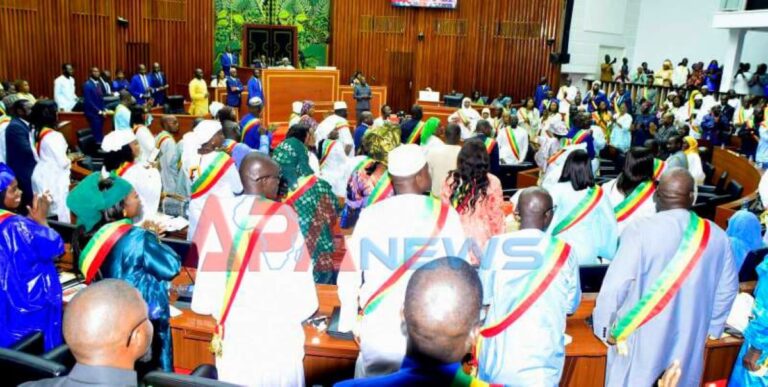
The committee’s position, reached at the end of its review of the 2027 initial finance bill (PLFI), came despite explanations from Minister of Economy, Finance and Planning Cheikh Diba and his government team. Committee members now ask the National Assembly to follow their recommendation when the text is considered in plenary session.
At the heart of the disagreement is a general budget set at 7,005.6 billion CFA francs in spending against projected revenue of 5,653.9 billion, a deficit of 1,351.7 billion CFA francs, or 4.7% of gross domestic product (GDP). The government presents this trajectory as a fiscal consolidation effort, following a deficit of 7.6% envisaged in the amended 2026 finance bill (PLFR), which lawmakers rejected.
But several committee members challenged the reliability of the macroeconomic framework and pointed to discrepancies among the draft budget, the economic and financial report and the annexes. They noted in particular differences in the growth forecasts, tax revenue, current transfers and the budget deficit, whose figures vary across the documents submitted to Parliament.
Lawmakers also noted a gap between the 2.4% growth rate cited in some documents and the 1.5% rate the minister gave orally for 2027. They said these inconsistencies could not be dismissed as clerical errors, given that they affect the assessment of the state’s financial balances.
The continued references to the 2026 PLFR, which the National Assembly rejected, also fueled criticism. Some lawmakers counted more than 120 references to that text in the budget documents and asked the government to clarify the legal and economic basis for the 2027 programming.
In response, Diba argued that the rejection of the amended finance bill did not erase the economic realities that had justified drawing it up. He said the references in question served as a basis for comparison, and announced that errata would be submitted and the economic and financial report reworked to make the data easier to read.
Public debt was another point of friction. Committee members asked for details on the financial commitments identified in the public finance audits, how bank debt would be handled and the negotiations with the International Monetary Fund (IMF). They also asked for access to the documents on the 2026-2029 three-year program, announced at $2.2 billion, so they could assess its commitments and its economic and social consequences.
The government defended its debt strategy, presenting it as a way to restore sustainability, secure state financing and preserve the stability of the West African Economic and Monetary Union (UEMOA) regional financial market. It also said Senegalese debt securities issued on the regional money and financial markets were excluded from the scope of the planned reprofiling.
Energy subsidies also raised questions. Ministers disclosed that the financing needs for these subsidies in 2026 reached about 790 billion CFA francs, against 250 billion originally included in the finance law, an overrun of some 540 billion. The rejection of the amended bill complicates the settlement of these additional costs, and how they will be covered remains to be determined.
Beyond the financial balances, the debates centered on the government’s social and economic choices. The doubling of the family security grants allocation, raised to 140 billion CFA francs in 2027 from 35 billion in the initial 2026 finance law, was welcomed by some lawmakers, while others asked for guarantees on its financing and targeting.
The bill also provides 480 billion CFA francs to clear arrears owed to businesses, and 22 billion CFA francs for a new restructuring fund for struggling companies.
The latter initiative drew reservations given the number of public financing mechanisms already in place and the government’s commitments to streamline them.
Investment in infrastructure, health and education was also reviewed, including the construction of five hospitals in Bakel, Mbour, Ziguinchor, Kaolack and Saint-Louis, for a total of 416 billion CFA francs in commitment authorizations, as well as the continuation of school construction and rural connectivity programs.
Despite the explanations from the government team, the disagreements were not resolved. The committee’s rejection of the revenue estimates, the debt provisions and the budgets of the public authorities is a signal of parliamentary distrust of the financial framework proposed for 2027, without prejudging the outcome of the bill’s review in plenary session.
TE/Sf/lb/as/APA