



The global race for critical minerals in Central Africa offers countries in the region prospects for revenue and development, but also exposes their resources to organised crime, corruption and geopolitical rivalries, according to a report by the Global Initiative Against Transnational Organised Crime (GI-TOC) published in November.
Titled “Vulnerable Wealth: Who will profit from Central Africa’s critical minerals?”, the report, authored by Zobel Behalal and Romain Esmenjaud, examines vulnerabilities in the mining sector in the Democratic Republic of Congo (DRC), Gabon, Chad, Cameroon and the Central African Republic (CAR).
The study notes that sub-Saharan Africa holds about 30 percent of the world’s critical mineral reserves, which have become essential to the energy transition, digital technologies and defence industries.
Global demand for copper is expected to rise by 28 percent over the next 10 to 15 years while demand for lithium could increase by more than 350 percent, according to International Energy Agency projections cited in the report.
The DRC is central to this dynamic, with more than 70 percent of global cobalt production and more than 50 percent of coltan production.
Mining accounts for about 95 percent of its exports by value and 40 percent of its gross domestic product (GDP) in 2024.
Gabon, the world’s second-largest manganese producer, mined nearly seven million metric tonnes in 2024 while Chad is developing its antimony mining and Cameroon has deposits of cassiterite, lithium, cobalt and nickel.
This mineral wealth is attracting China, the United States, the European Union, the United Arab Emirates and Japan, which are multiplying partnerships and initiatives to secure their supplies.
The report cites the strategic partnership between Washington and Kinshasa on critical minerals, as well as the Lobito Corridor project, backed by the US and the European Union, to facilitate the transport of mineral resources from the DRC and Zambia to the Angolan port of Lobito.
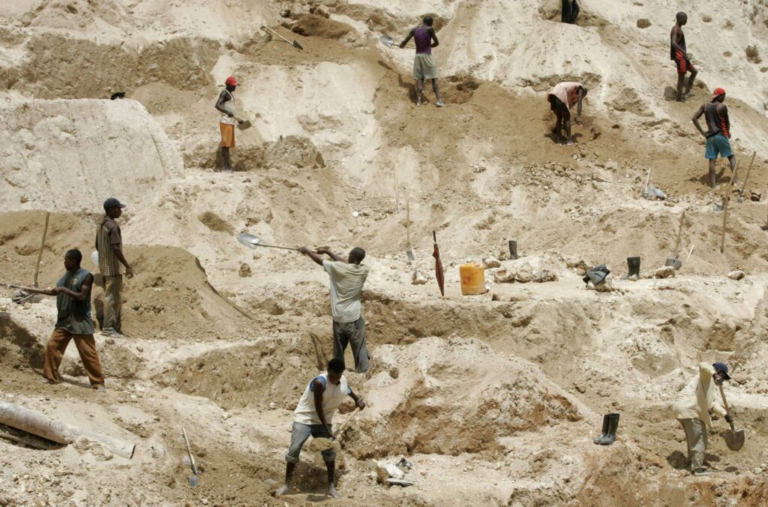
But this international competition is unfolding in an environment marked by weak oversight, informal artisanal mining and a limited government presence in some mining areas.
According to the authors, these factors encourage smuggling, money laundering, corruption and the financing of armed groups.
In the DRC, the report notes that the M23 armed group controls the Rubaya mining area in North Kivu, which is said to account for more than 15 percent of the global tantalum supply.
The group is said to control access to extraction sites and trade routes and to facilitate the transfer of up to 200 metric tons of coltan a month to Rwanda where the ore is allegedly mixed with local production to conceal its origin.
The document also describes illegal artisanal mining of copper and cobalt in Lualaba and Haut-Katanga provinces, with revenues estimated at about $2 billion a year.
These activities reportedly enjoy protection from members of the security forces, provincial authorities and networks close to the political elite.
In Chad, the authors highlight the capture of the antimony sector by political and security networks.
Mining of the ore in Tibesti is said to be controlled by companies owned by military officials, while Chinese, Turkish and Libyan intermediaries are reported to be involved in its marketing and export.
Chad exported nearly 10,000 metric tons of raw antimony in 2025, according to the country’s National Institute of Statistics, Economic and Demographic Studies.
In Cameroon, the report points to a large gap between official gold exports and importing countries’ data.
In 2023, the country declared 22.3 kilogrammes of gold exports, while the United Arab Emirates recorded more than 15 metric tons of gold from Cameroon.
In the CAR, the authors recall that smuggling accounted for up to 90 percent of diamond production in 2019, worth an estimated $15 million, before stabilising at around 50 percent in 2021, or $7.5 million.
The report also expresses concern over the arrival in the emerging critical minerals sector of actors associated with opaque practices already seen in the gold and diamond trades.
Beyond mining crime, the study warns of “geo-criminality,” defined as the use of criminal practices by states to pursue economic, strategic or security goals.
It cites influence operations attributed to Africa Politology, an entity linked to the Wagner Group that later came under the control of Russian foreign intelligence, aimed at discrediting the Lobito Corridor in Angola, the DRC, Namibia and South Africa.
To address these risks, the authors recommend that Central African governments integrate the fight against organised crime into their mining policies, strengthen transparency on companies’ beneficial owners, subject traders and intermediaries to anti-money-laundering obligations, and strengthen the capacity of customs, financial intelligence units and mining police.
The report also calls on the Task Force on Money Laundering in Central Africa and the Financial Action Task Force to update their evaluation mechanisms to better account for risks linked to the mining, trade, transport and export of critical minerals.
AC/Sf/lb/jn/APA