



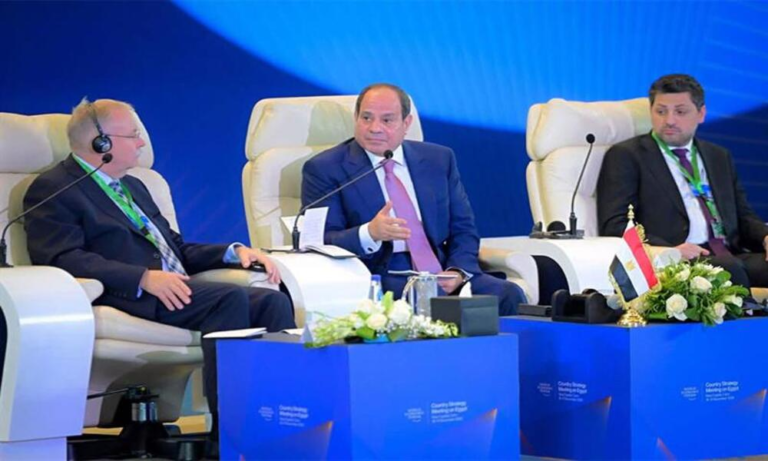
Egyptian President Abdel Fattah Al-Sisi has been defending his country’s economic reforms aimed at attracting foreign investors and strengthening the private sector, citing growth of 5.1% and foreign direct investment of $18 billion.
Al-Sisi outlined Egypt’s economic prospects on Tuesday, November 17, 2026, to nearly 80 representatives of major international companies and financial institutions gathered in Cairo for a World Economic Forum (WEF) strategic dialogue.
He reaffirmed the state’s determination to strengthen the private sector’s role in growth and to make Egypt more attractive to foreign capital.
According to figures provided by the president, the Egyptian economy grew 5.1% in fiscal year 2025-2026. Foreign currency reserves reached $57.5 billion at the end of October, while foreign direct investment stood at $18 billion. Private investment rose 25.9% in the first quarter of the fiscal year, and now accounts for 66% of total investment.
To support this momentum, Cairo intends to continue business climate reforms, including simplified administrative procedures, the “golden license” scheme and modernized customs procedures.
The average customs clearance time has reportedly been cut to two days. The government is also relying on a flexible exchange rate regime and on easing the repatriation of foreign investors’ profits.
Industrialisation is among the other stated priorities. The national strategy to 2030 aims to raise industry’s contribution to 20% of gross domestic product (GDP), with particular attention to electric vehicles, pharmaceuticals, solar equipment and information technology.
The state also plans to expand infrastructure, with nearly 1 trillion Egyptian pounds spent annually on modernization, according to Al-Sisi.
In the energy sector, Egypt aims to raise the share of renewables to 45% of its electricity mix by 2028.
The president also discussed prospects tied to regional interconnections and gas exports to Europe. He noted, however, that disruptions to Red Sea shipping had cost the Suez Canal an estimated $20 billion.
Finally, Al-Sisi highlighted opportunities in artificial intelligence, data centers and cloud computing, as well as the presence of Egyptian companies on several major African projects.
A national transformation program for 2027-2030, aimed at improving productivity and supporting growth, is to be presented in December.
MK/AK/Sf/lb/as/APA