





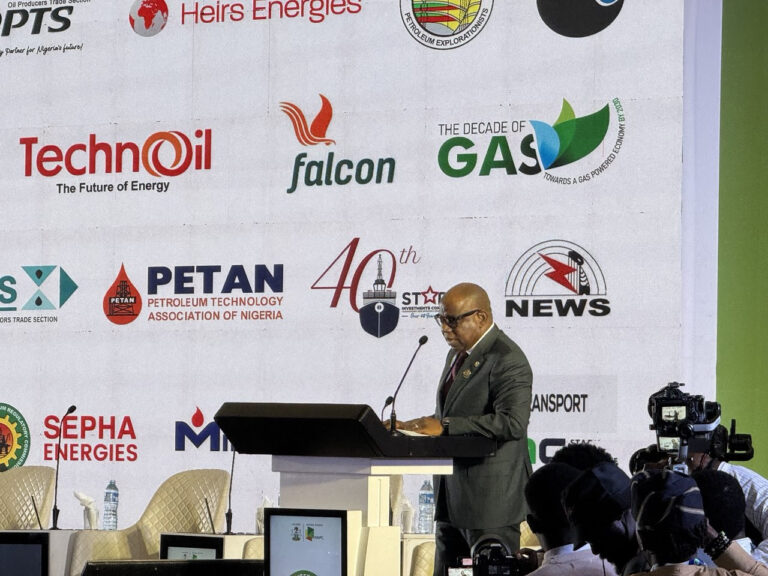
The Group Chief Executive Officer of Nigerian National Petroleum Company Limited (NNPCL), Engr. Bashir Ojulari says that pipeline vandalism, which is Nigeria’s critical oil infrastructure challenge, has largely been tamed,
Speaking during the fireside chat at the 9th Nigeria International Energy Summit (NIES) on Wednesday in Abuja, Ojulari described crude oil production as “fragile,” likening it to driving a car at high speed where attention can never waver.
“For me, production is like driving a car on a straight road. Don’t take your eyes off the road, don’t take your hands off the steering. If you do, you know exactly what will happen,” he said.
Ojulari credited the bold Nigerian government intervention working in concert with the NNPCL for reversing what had become an existential threat to Nigeria’s crude oil output.
He recalled that two years ago, pipeline vandalism reduced effective evacuation volumes to as low as 5 per cent in some corridors, leaving operators helpless and investment confidence shattered.
The government’s surveillance architecture, he said, marked a turning point. The framework combines advanced technology such as drones and real-time monitoring from a command centre in Abuja, kinetic security involving armed patrols and critically community engagements.
According to Ojulari, it was the social component that had been underplayed before his arrival.
“When we came in, the kinetic side was working, policing, patrols, but the social responsibility to the communities was not being done enough,” he said.
“And unless you approach the Niger Delta as a social problem, not just a security problem, you will keep chasing your tail.”
Ojulari said that the NNPCL redirected focus toward community support, insisting that security contractors demonstrate tangible social performance in host communities alongside physical protection of assets.
He explained that this shift, rather than increased spending, helped improve reliability across key pipeline routes.
He added that the NNPCL also addressed structural inefficiencies by aligning pipeline maintenance and security under a more integrated accountability framework, reducing duplication and costs.
The collaboration with partners such as Renaissance, he said, created a workable template that balances security, maintenance, and commercial efficiency.
However, despite improved pipeline uptime, Ojulari acknowledged that production has not risen as sharply as expected. The reason, he explained, lies in years of underinvestment.
“We secured the pipelines, but then we asked ourselves, where is the production?”
“The lack of investments over the years is now showing.” he added.
According to him, Nigeria failed to build a pipeline of producible projects and redundancy into its production systems.
“It is for this reason that the NNPCL is now working with partners to accelerate contracting cycles, attract fresh capital, and prioritise production-enhancing activities.
“We need more investments, more rigs, more activities,” The pipelines are ready. Now we must feed them,” he added.
GIK/APA