





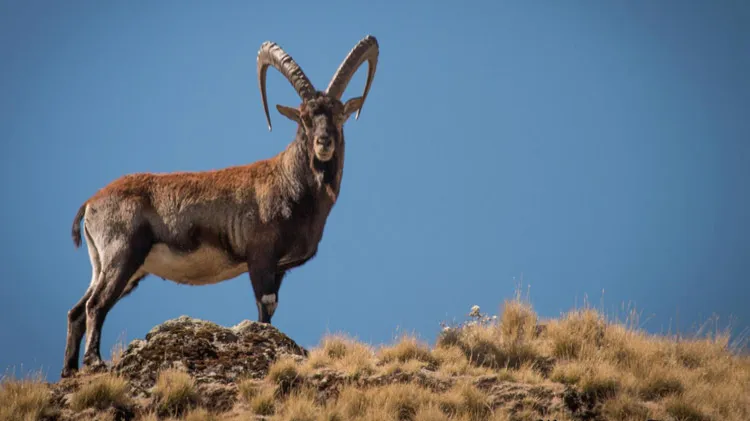
The Walia Ibex, a rare wild goat endemic to Ethiopia, has been reclassified as critically endangered in 2026 after surveys and a recent study found the species have declined below a key population threshold, the International Union for Conservation of Nature (IUCN) said on Friday.
According to IUCN, in December 2025, the number of Walia Ibex was recorded as 271 in Simien Mountains National Park in northern Ethiopia.
Its entire global population is confined to this single protected area, making it one of the world’s most range-restricted large mammals.
The reclassification was triggered by findings from a study published in the journal Orxy by Paul Scholte and colleagues, which documented a decline from 865 animals in 2015 to 306 by May 2024.
The study found that the number of mature individuals, the measure used by the IUCN to assign threat categories, had fallen below 250 in both 2023 and 2024.
An additional count in November 2024 recorded 289 ibex, including 228 mature individuals. By December 2025 the total had dropped further to 271.
The species’ Red List status has shifted several times as population estimates rose and fell. It was listed as endangered in 1986, critically endangered in 1996, endangered again in 2008, and then vulnerable after the 2020 assessment.
Between 2009 and 2012, surveys had found the population increasing from 680 to 850 individuals, and researchers estimated it would exceed 975 by 2020. That optimism underpinned the vulnerable classification.
Poaching was identified as a major reason for the decline, killing the wild for food and traditional medicine. Human encroachment and habitat degradation were also cited as major pressures.
Two overlapping crisis worsened the situation. During the COVID-19 pandemic, tourist flows were disrupted, revenues fell and patrolling activities stopped.
The 2021–2022 war between the Ethiopian government and the Tigray People’s Liberation Front (TPLF) then increased opportunities for poaching as enforcement weakened.
Poaching remained active said IUCN, citing an April 2025 incident in which four poachers were apprehended and the remains of two Walia ibexes were confiscated.
The Ethiopian Wild Life Conservation Authority (EWCA) also points to additional pressures, including agriculture and livestock grazing expansion, weak enforcement of wildlife protection laws, and community resistance to conservation restrictions on land use.
“The species’ specialized habitat requirements and low reproductive rate make it vulnerable to extreme fluctuation under these combined pressures,” the EWCA added.
MG/GIK/APA