





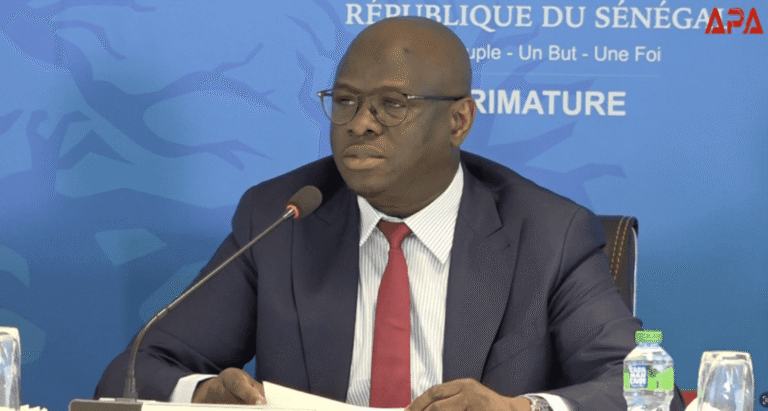
The Finance, Economic Affairs, and Law Committees of the Senegalese National Assembly have unanimously adopted draft law No. 09/2026 on factoring during a joint inter-committee session.
Chaired by Chérif Ahmed Dicko, the legislative meeting included key administration figures, notably the Minister of Finance and Budget, Cheikh Diba, and government spokesperson Marie Rose Khady Fatou Faye. The new bill aims to establish a dedicated, transparent legal framework for factoring—a financial practice where companies sell their commercial trade receivables to a specialized institution for upfront cash—which has historically operated in Senegal without specific regulatory guidelines.
Until now, factoring inside Senegal was loosely governed under a broad banking law from 2008 that lacked tailored provisions for the sector. To close this legal gap, the new bill formally integrates a uniform law adopted by the West African Monetary Union (UEMOA) Council of Ministers, standardizing rules across the entire monetary zone. Minister Cheikh Diba emphasized that small and medium-sized enterprises (SMEs) are at the absolute center of this structural reform. Pointing to data from the national statistics agency, Diba noted that while SMEs make up 99.8% of Senegal’s business landscape, they generate just 30.4% of total corporate turnover. Compounding the issue, 70% of these small businesses explicitly list a lack of traditional bank financing as their primary obstacle to growth.
The urgency of the legislation is underscored by Senegal’s lagging credit landscape, with bank credit penetration sitting at a low 31.1% of GDP, far behind African peers like Morocco at 83.4% and South Africa at 130%. To counter this, the bill introduces a major regulatory innovation by formally authorizing microfinance institutions to provide factoring services. Lawmakers widely praised this modification, noting it will decentralize funding and bring credit options directly into local and rural economies. The Finance Minister also clarified that this law will directly complement upcoming leasing legislation, explaining that while leasing is designed to help businesses fund long-term equipment investments, factoring is tailored to solve their day-to-day operational cash flow needs.
During the session, several lawmakers pushed for precise clarifications on how the law defines valid corporate receivables, while also raising concerns over the potential for overly aggressive debt recovery procedures against vulnerable local companies. Minister Diba expressed strong openness to these parliamentary critiques, ordering his staff to provide technical support to ensure consumer protection safeguards are clear. Following its unanimous approval by the joint committees, the landmark financial bill will now move directly to the floor of the full National Assembly for a final legislative vote.
AC/Sf/lb/abj/APA