



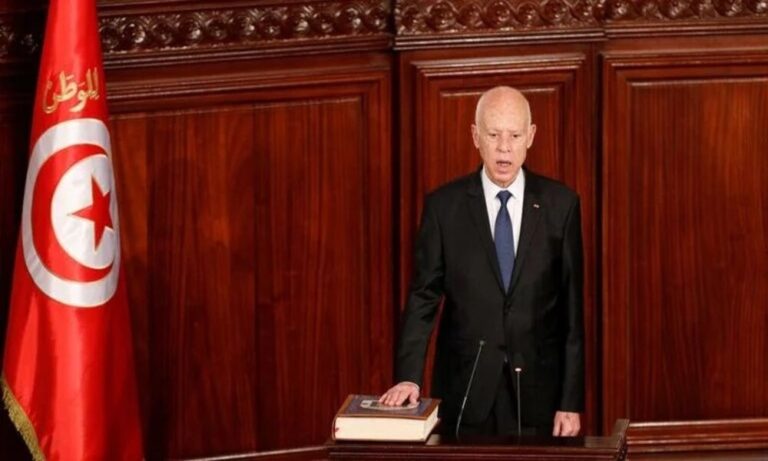
The Tunisian authorities have through the promotion of new security force officers, reaffirmed the importance of security issues in the state’s discourse and presented as a lever forsovereignty, stability and the restoration of public authority.
During a ceremony held in Kairouan to mark the graduation of the “Marouane Kaderi” class, the Tunisian Minister of Interior described security as a “sacred mission,” a phrase that aligns with the discourse promoted for several years by President Kais Saied.
Security now appears as one of the main markers of public action, on par with national sovereignty and the fight against corruption. The graduation of 950 officers from various security academies comes at a time when the authorities regularly highlight operations conducted against criminal networks, drug trafficking and various forms of organized crime.
Drug seizures, arrests and the dismantling of networks are thus presented as concrete manifestations of a policy aimed at strengthening state control over the entire territory.
Beyond the operational dimension, this approach contributes to the construction of a broader political narrative. Since 2021, the Tunisian government has frequently linked the restoration of state authority to the consolidation of internal security.
In this interpretation, security stability is a prerequisite for the country’s institutional, economic and social recovery.
The official discourse, however, seeks to reconcile firmness and legality. By emphasizing the need to “apply the law without forgetting dignity,” the Minister of Interior stressed the importance of preserving the relationship of trust between the security forces and citizens.
This reference reflects the authorities’ stated intention to present security action not only as an instrument of legitimate coercion, but also as a mechanism for protecting the population.
The new graduates were called upon to join the judicial police, intervention units and other operational structures, thus embody, in the government’s discourse, a new generation of agents tasked with strengthening the state’s presence and responding to contemporary security challenges.
In a region facing multiple risks, ranging from cross-border trafficking to threats linked to organised crime, security remains one of the main pillars of legitimacy for the Tunisian government.
Highlighting operational results and increasing personnel numbers are part of this strategy aimed at making the security institution a symbol of stability and continuity of the state.
Beyond the ceremony in Kairouan, the message conveyed by the authorities is clear: security is now presented as one of the cornerstones of the current government and as a central element of the political project championed by President Kais Saied.
MK/AK/Sf/fss/gik/APA