



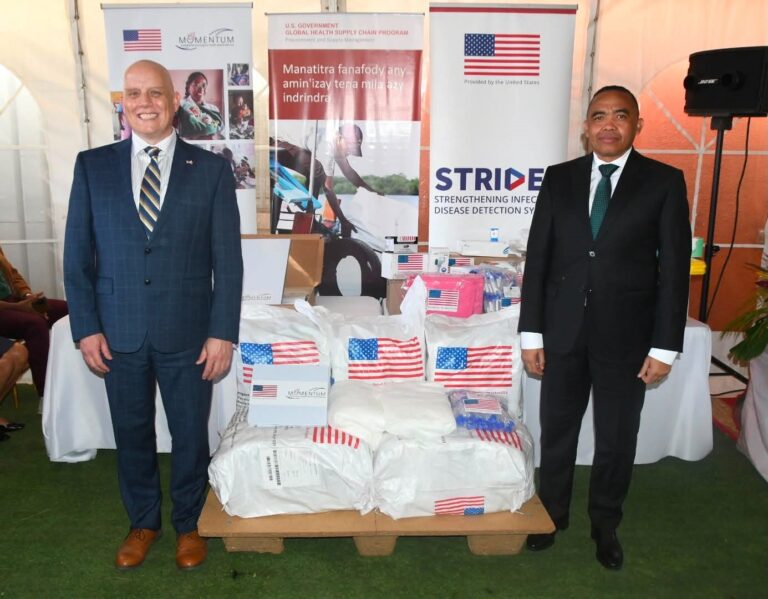
The United States has handed over a major consignment of medical equipment and supplies to Madagascar to strengthen disease prevention and outbreak detection across the Indian Ocean island.
The delivery, valued at more than $2.2 million, includes nearly one million mosquito nets, more than 900,000 pieces of laboratory and medical equipment, and 33 satellite internet systems for remote health facilities.
US Chargé d’Affaires Steve Bremner presided over the handover to President of the Refoundation Michaël Randrianirina on Monday, describing the assistance as a strategic investment in Madagascar’s ability to detect and contain infectious diseases before they spread across borders.
“Every US taxpayer dollar must show measurable results, reduce long‑term dependence on US resources and support greater self‑reliance,” Bremner said, adding that stronger Malagasy health systems ultimately protect both American and Malagasy families.
The mosquito nets – 989,250 long‑lasting insecticide‑treated units worth $2 million –
will be distributed to 63 districts and more than 1,600 community health centres between July and mid‑October.
Malaria remains one of Madagascar’s leading causes of death and the US‑funded Global Health Supply Chain Programme will oversee distribution of the nets, the final shipment of which arrived in late June.
The package also includes 908,523 pieces of medical and laboratory equipment valued at $180,000, ranging from personal protective gear and diagnostic tools to cold‑chain supplies and digital surveillance systems.
The support is intended to bolster Madagascar’s capacity to detect and respond to outbreaks of diseases such as monkeypox, plague, rabies, polio and Ebola.
A further $30,000 will fund the procurement, installation and first year of service for 33 Starlink satellite internet systems at priority district and regional health offices.
The systems will allow health workers in remote areas to transmit data quickly to central authorities, enabling faster and better‑coordinated responses to emerging health threats.
JN/APA