





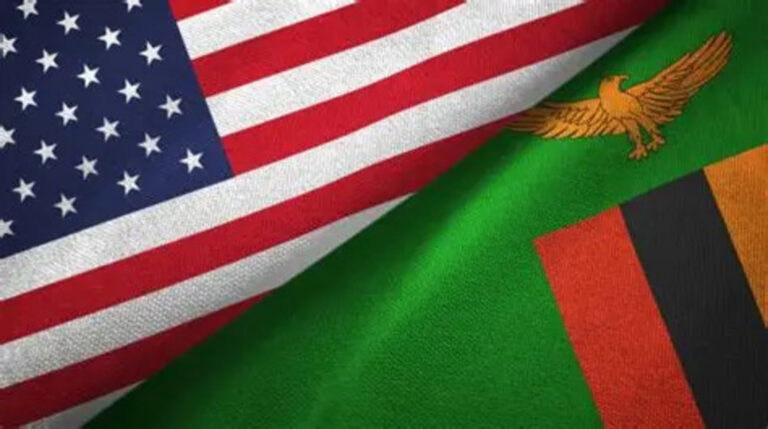
Zambia’s escalating dispute with the United States has laid bare the difficult terrain African governments navigate when negotiating with powerful donors whose financial leverage often shapes the terms of engagement.
What began as a routine farewell speech by outgoing US Ambassador Michael Gonzales has spiralled into one of Lusaka’s most public diplomatic confrontations in years, revealing deeper tensions over aid, minerals and the limits of sovereignty in donor‑recipient relationships.
The row erupted after Gonzales used his departure to sharply criticise Zambia’s anti‑corruption record, question governance appointments and accuse officials of dragging their feet on key bilateral agreements.
His remarks landed just months before Zambia’s August general election, immediately triggering political debate and prompting an unusually forceful response from the Lusaka authorities.
Foreign Affairs Minister Mulambo Haimbe accused the ambassador of breaching diplomatic norms and misrepresenting Zambia’s governance efforts.
However, the strongest pushback came as officials disclosed new details about a proposed US$2 billion health package that has been under negotiation for months.
According to the government, talks stalled because Washington insisted on data‑sharing provisions that Lusaka believed violated citizens’ privacy rights.
Those clauses, now the subject of legal scrutiny, became a flashpoint in the broader dispute.
The government also revealed friction over a proposed critical minerals framework with the US.
Officials said Zambia rejected terms that appeared to give American companies preferential access to the country’s mineral wealth, and objected to what they described as attempts to link progress on the minerals agreement to the health package.
Haimbe said Zambia would not accept arrangements that undermined national control over strategic resources or treated one partner as inherently privileged.
The dispute has drawn attention to a wider shift in Washington’s approach to Africa under President Trump’s “America First” strategy, which has increasingly framed aid as a transactional tool.
Analysts and health experts have noted that the new approach has placed greater emphasis on access to sensitive health data and on securing strategic advantages in sectors such as minerals, which are essential for the global green energy transition.
The minerals dimension is particularly significant in Zambia, one of the world’s major producers of copper and cobalt.
These minerals are central to solar technologies, electric vehicle batteries and energy storage systems.
The US has been seeking to counter China’s long‑established presence in Zambia’s mining sector, and the proposed framework was widely viewed as part of that broader geopolitical contest.
The health package, meanwhile, represents one of several agreements the US is pursuing across Africa as it reshapes decades of engagement previously anchored in agencies such as USAID and PEPFAR.
Critics argue that the new model risks weakening already strained health systems by making support contingent on conditions that some governments view as intrusive or misaligned with domestic priorities.
Gonzales had earlier accused Zambian leaders of failing to act on corruption in the health sector and of ignoring US efforts to finalise the agreement.
Haimbe, however, countered that Zambia would not accept data‑sharing demands that compromised privacy or terms that subordinated national interests in the minerals sector.
The dispute has become more than a diplomatic spat.
It offers a revealing snapshot of how African governments can find themselves negotiating within frameworks where donors hold disproportionate leverage – especially when essential funding, health support and access to global markets are at stake.
JN/APA