



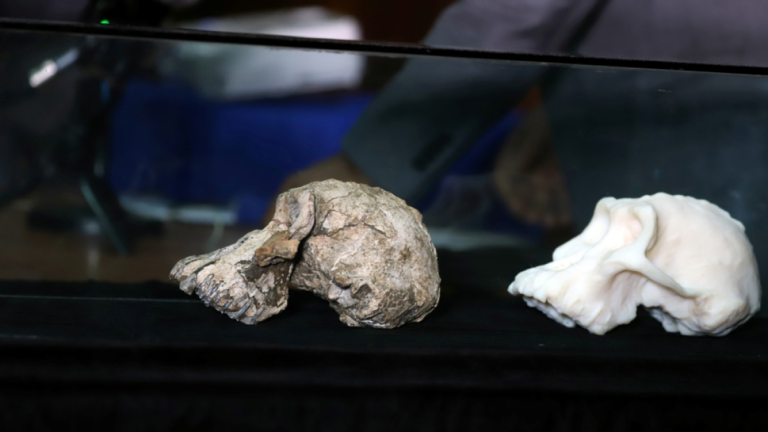
A 2.6-million-year-old hominin species fossil remains has been found in Ethiopia’s Afar region, paleoanthropologists in the University of Chicago have disclosed.
Briefing journalists on Wednesday in Addis Ababa, Ethiopia’s capital, Zeresenay Alemseged, a paleoanthropologist and professor at the University of Chicago, said the newly- discovered fossil is the first known specimen of Paranthropus ever discovered in Ethiopia and is among the oldest remains anywhere in Africa.
The discovery will reshape paleoanthropologists’ understanding of one of humanity’s ancient relatives, suggesting that a robust branch of early hominins was far more widespread and adaptable than previously believed. “Geological and magnetostratigraphic evidence place the fossil securely between roughly 2.9 and 2.5 million years ago, during a period marked by significant environmental change in eastern Africa,” said Alemseged.
Until now, Paranthropus fossils had been documented from southern Ethiopia to South Africa, but not from the Afar region. The new discovery indicates that Paranthropus had a broader geographic range from its earliest known appearance than previously recognized.
“While some experts suggested that dietary specialization restricted Paranthropus to southern regions, others hypothesized that this could have been the result of Paranthropus’ inability to compete with the more versatile Homo,” he added.
Alemseged pointed out that many paleontological and archaeological sites across the country have yielded hominin fossils and stone tool artifacts spanning the entire history of the human lineage going back to 6 million years ago.
MG/abj/APA