





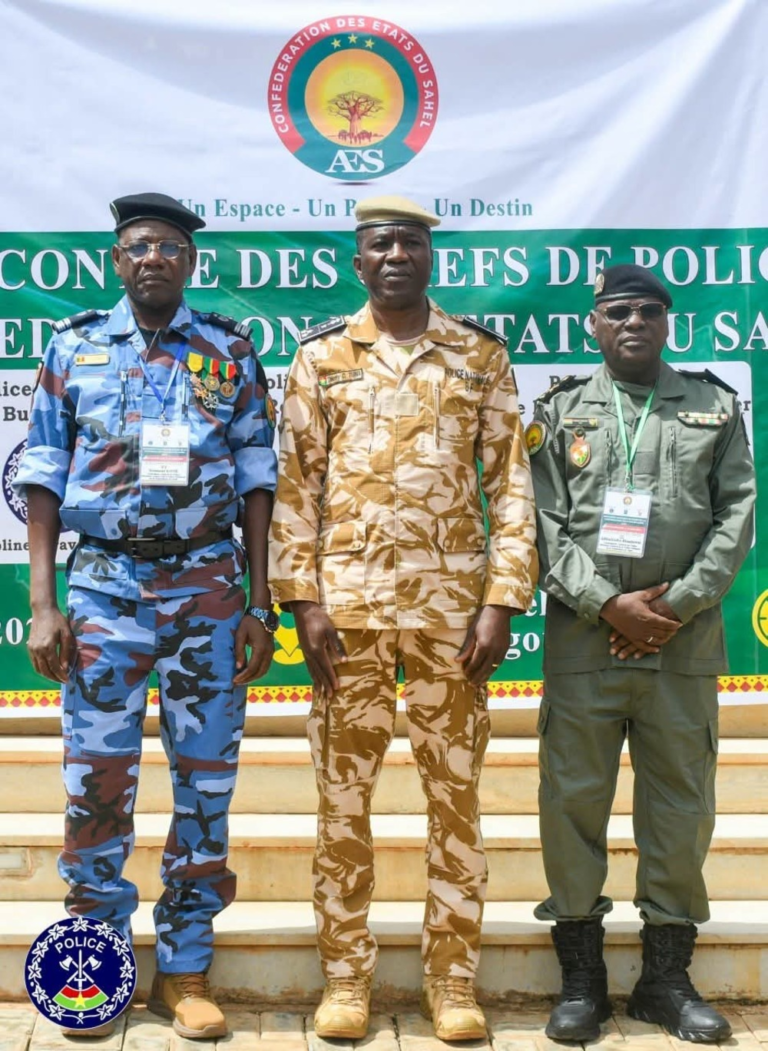
The directors general of the police forces of Burkina Faso, Mali, and Niger have opened their second coordination meeting in Ouagadougou, aimed at accelerating security integration within the Confederation of Sahel States (AES) through stronger operational cooperation, enhanced intelligence sharing, and the harmonization of border control procedures.
The meeting, which runs through July 17, 2026, seeks to translate into concrete, actionable measures the decisions previously adopted during the AES security ministers’ summit held on July 1 in the Burkinabe capital. The working session is chaired by Burkina Faso’s Director General of National Police, Inspector General Thierry Dofizouho Tuina, alongside Mali’s Director General, Controller General Youssouf Koné, Niger’s Director General, Commissioner General Assahaba Ebankawel, and Colonel Ernest Auguste Guiwassa Yelemou, the AES Commission’s official in charge of defense and security affairs. This high-level gathering follows the first meeting of the Confederation’s police chiefs held in Bamako in early 2025, building upon the recent adoption of a technical arrangement to streamline roadside inspections and the validation of a draft protocol dedicated entirely to internal security.
Police officials are actively seeking to standardize inspection procedures along major regional transport corridors to simultaneously tighten security and facilitate the legitimate movement of people and goods, a move expected to drastically curb extortion, illegal levies, and harassment frequently reported by travelers and transport operators. A primary focus of the discussions centers on the gradual interconnection of the three countries’ information systems, which will eventually grant authorized agencies direct access to unified databases containing tracking information on wanted persons, stolen vehicles, and reported items. Cooperation is also expanding deeply into forensic policing, complex criminal investigations, public order management, personnel training, and the sharing of specialized tactical equipment.
The ongoing strengthening of this trilateral alliance is designed to directly confront the common security challenges plaguing the region, including terrorism, arms and drug trafficking, human smuggling, cybercrime, and transnational criminal networks. Highlighting the urgency of the situation, Mali’s Director General of National Police called for faster real-time intelligence exchanges and the development of joint border operations, emphasizing the critical need to adapt modern investigative methods to emerging threats linked to digital technologies and artificial intelligence. While participants openly acknowledged that the ultimate success of this regional cooperation will depend heavily on the seamless networking of databases and the compatibility of their respective information systems, the stated objective remains clear: to solidify police cooperation as the foundational operational pillar of AES security integration.
MD/te/Sf/lb/abj/APA