



A new report by the think tank Power Shift Africa estimates that Africa could generate up to €4.5 trillion (approximately $5 trillion) by 2050 through a comprehensive shift from fossil fuels to renewable energy.
This monumental economic gain, however, hinges on the continent’s ability to overcome significant structural constraints.
The study highlights that Africa’s energy transition has the potential to yield savings ranging from $3 trillion to $5 trillion (€2.75 trillion to €4.5 trillion) by mid-century, alongside the creation of millions of jobs. Despite a notable surge in investment in solar and wind energy, this transformative shift continues to be hampered by major challenges: persistently low electrification rates, the enduring dominance of fossil fuels, and a critical lack of accessible financing.
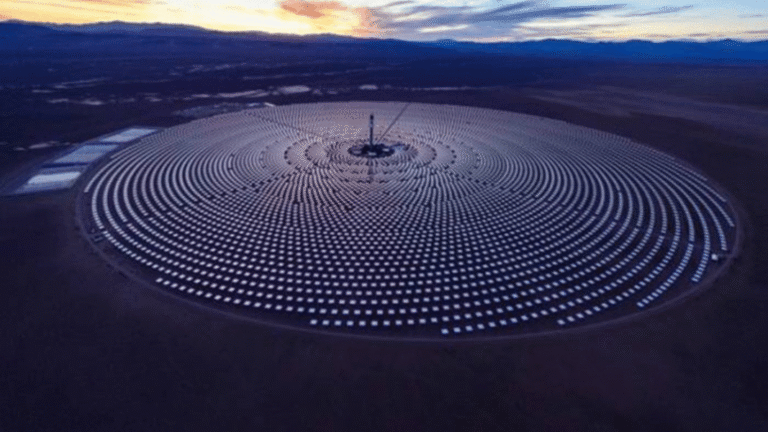
In 2023, Africa achieved a symbolic milestone as its installed renewable energy capacity surpassed fossil fuel capacity for the first time, with an additional 7.9 gigawatts brought online. Solar photovoltaics, in particular, are experiencing strong momentum, with investments tripling in just five years, from $17 billion to $40 billion (approximately €37 billion). Projects like the Noor complex in Morocco and Kenya’s geothermal strategy exemplify this growing ambition.
Persistent challenges and financial gaps
Despite this positive upturn, the continent faces significant structural inertia. Fossil fuels are still projected to represent nearly 69 percent of installed capacity on the continent through 2035. Oil, gas, and coal continue to power the majority of national electricity systems, especially in Southern and West Africa.
One of the primary impediments to the energy transition remains financial. Public and concessional investments saw a one-third decline by 2024, reaching only $20 billion (€18.5 billion), partly due to the gradual withdrawal of Chinese development banks. Concurrently, the cost of capital remains exceptionally high for African projects—between three and seven times that of developed countries. Power Shift Africa underscores that, despite Africa’s substantial demographic weight (nearly 20 percent of the world’s population), the continent attracts only 3 percent of global investments in clean energy. The stark consequence is that 600 million people still lack access to electricity, and nearly a billion continue to rely on wood or coal for cooking.
The African Union has set an ambitious target of 300 gigawatts of renewable capacity by 2030. However, at the current pace, only 57 percent to 65 percent of this goal is likely to be achieved. To bridge this gap, annual installation volumes would need to quadruple by 2025.
Economic potential and sovereignty dilemmas
Nevertheless, the economic outlook remains considerable. Power Shift Africa projects that the renewable sector could employ up to five million people by 2050, a significant increase from the current approximately 350,000. This growth, however, is contingent on expanded access to subsidized capital, robust guarantee mechanisms, and regulatory stability.
In resource-rich countries like South Africa, Nigeria, and Angola, revenues from oil, gas, and coal form the backbone of state budgets. Consequently, a rapid exit from these sectors presents a significant sovereignty dilemma. As one senior official in Pretoria explained, “coal structures our entire economy. It cannot be phased out overnight without devastating social and budgetary consequences.”
Just Energy Transition Partnerships (JETPs), already being piloted with South Africa, offer a hopeful framework. These partnerships facilitate the channeling of funding towards an inclusive transition, crucially led by the states themselves, providing a potential path forward for balancing economic stability with climate goals.
MK/ac/Sf/fss/abj/APA