



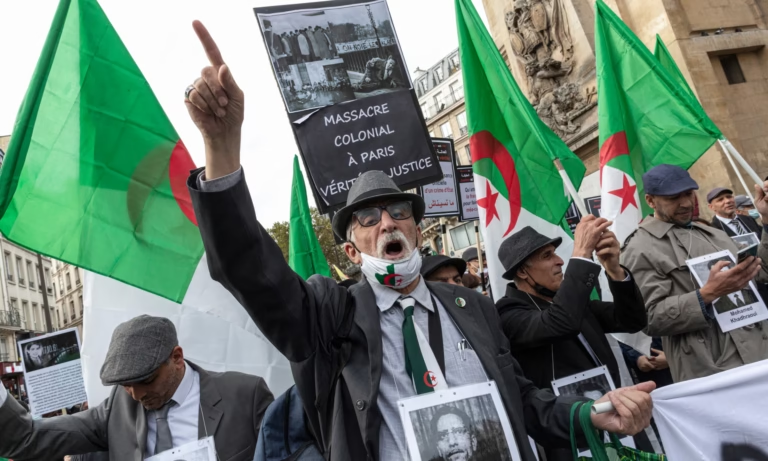
Algeria on Thursday commemorated the 64th anniversary of the bloody repression of October 17, 1961, when dozens of Algerians were killed by French police during a peaceful march for independence in Paris.
As has been the case every year since 2021, a minute of silence was observed across Algeria on October 17, following instructions from President Abdelmadjid Tebboune.
In a message released to mark the occasion, the head of state described October 17 as an “immortal moment in the national memory,” symbolizing “the unity of the Algerian people in their struggle against colonialism.”
The solemn address forms part of a broader strategy of memory politics that the Algerian government has consistently employed, often coinciding with renewed periods of tension with France.
Deeply rooted in Algeria’s national consciousness, the commemoration remains asymmetrical in nature: it serves primarily to reaffirm the historical legitimacy of the ruling authorities rather than to foster a balanced dialogue on shared memory.
While the repression of October 17, 1961, remains a defining event in Algeria’s identity, its official evocation often downplays historical complexity and functions as a diplomatic instrument in the country’s uneasy relationship with France.
This year’s observance comes at a time when Franco-Algerian relations are at their lowest point since 2024. The recall of Algeria’s ambassador from Paris, followed by reciprocal diplomatic expulsions and the renewed “visa war,” has entrenched a climate of mutual distrust between the two capitals.
In this context, the commemoration of October 17 carries political as well as historical overtones. Algiers seeks to reaffirm its symbolic sovereignty vis-à-vis a France perceived as reluctant to fully acknowledge its colonial responsibilities.
For its part, Paris has multiplied symbolic gestures since President Emmanuel Macron’s 2021 recognition of the “inexcusable crimes” committed, though these have fallen short of meeting Algeria’s expectations.
On October 17, 1961, acting on the orders of Paris police Chief Maurice Papon, French police brutally suppressed a peaceful demonstration organised by the National Liberation Front (FLN).
Dozens of Algerians were killed, some drowned in the River Seine and nearly 12,000 were arrested, according to historians.
While France’s gradual acknowledgment of the tragedy has marked an important milestone, a genuine reconciliation of memories has yet to take place. Algeria continues to demand official apologies, whereas France maintains a stance of being “clear-eyed but not repentant.”
MK/sf/lb/gik/APA