





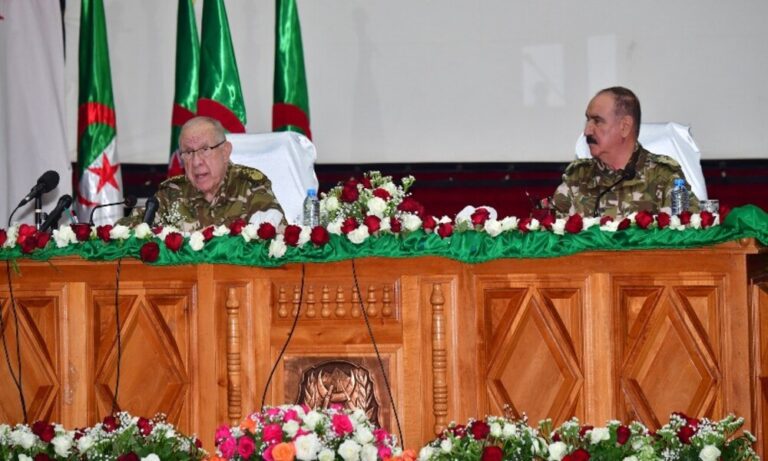
General Saïd Chanegriha, Chief of Staff of the People’s National Army, recently conducted a high-level visit to Algeria’s 6th Military Region as part of the 2025–2026 combat readiness program.
This mission, highlighted in an official Ministry of Defense statement, serves as a key component of the state’s public relations strategy to demonstrate military presence and resolve in a southern border region characterized by ongoing security challenges. Official communication surrounding the visit heavily emphasizes the “remarkable results” achieved by the armed forces in neutralizing residual terrorist threats and dismantling transnational drug trafficking networks.
The state’s narrative frames national stability as being inextricably linked to military vigilance and the coordination between various security services. However, this institutional discourse largely focuses on projecting an image of control and determination without providing verifiable data or independent indicators to substantiate the scale of these operational successes. This approach tends to prioritize military-centric reporting over a more holistic analysis of the socio-economic factors that often drive security issues in border regions.
Furthermore, the repeated emphasis on combating smuggling and narcotics suggests that structural vulnerabilities at the frontiers remain a significant concern, despite frequent reports of tactical progress. The reliance on centralized, official messaging underscores a communication policy designed to project territorial authority in a sensitive regional environment. Ultimately, the lack of transparent, consolidated indicators reinforces an institutional focus on demonstrating total command rather than providing detailed public transparency regarding the specific outcomes of these security operations.
As of April 9, 2026, the visit by General Saïd Chanegriha underscores Algeria’s commitment to securing its vast southern frontiers. While the rhetoric remains focused on military readiness and sovereignty, it highlights a regional reality where border security is paramount. The primary challenge remains balancing these security-first narratives with broader transparency to address the underlying pressures along the Sahelian borders effectively.
MK/AK/fss/abj/APA