



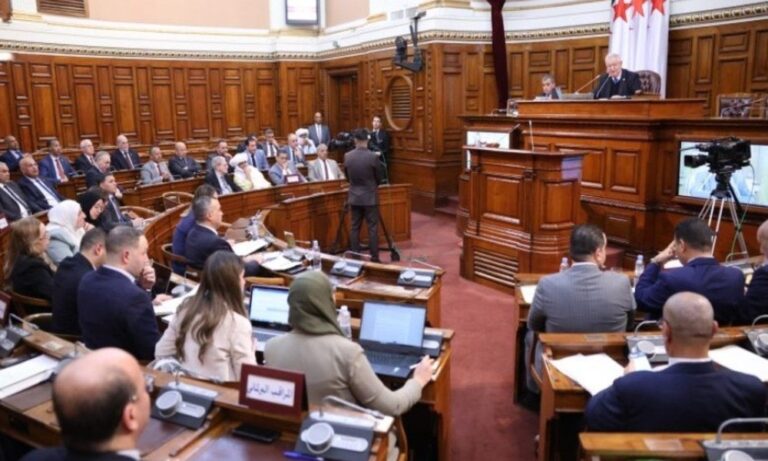
Algeria’s upper house of parliament has unanimously adopted a series of reservations on 11 articles of the new highway code, opening a fresh phase of institutional negotiations over legislation widely criticized for its excessively punitive approach.
The Council of the Nation on Tuesday delivered what amounts to an awkward verdict on the draft law introducing the new code.
All 156 members present, including 22 represented by proxy, unanimously endorsed the reservations raised by the Committee on Equipment and Local Development concerning 11 key articles of the text, while approving the remaining provisions. The vote reflects persistent unease over a bill presented by the executive as a structural reform but heavily contested for its repressive philosophy.
In a supplementary report, the committee explicitly called for the rejection of the bill “in its current form,” pointing to provisions deemed disproportionate, notably the sharp increase in fines and the tightening of criminal penalties.
Particular concern was expressed over custodial sentences provided for cases of involuntary manslaughter, considered excessive in light of the principle of proportionality between the offense and the sanction. In total, 11 of the 190 articles in the draft law are affected.
While acknowledging the stated objectives of the bill—improving road safety, reducing accidents and protecting human life—the committee criticized what it described as an unbalanced approach overly focused on repression.
It advocated a more comprehensive vision that, beyond sanctions, would include infrastructure upgrades, stronger prevention measures, road safety education and the mobilisation of all stakeholders, from local authorities to road users.
This institutional disagreement now paves the way for the convening of a joint committee between the two chambers of parliament, in accordance with Article 145 of the constitution and Organic Law No. 16-12.
Comprising ten members from each chamber, the committee will be tasked, within a defined timeframe, with proposing a revised version limited to the disputed provisions—a procedure that highlights the limits of parliamentary consensus around a bill nonetheless described as the product of “several years of multisectoral work.”
Addressing the session, Minister of the Interior, Local Authorities and Transport Saïd Sayoud sought to defuse criticism by asserting that the bill is not merely a repressive arsenal but aims to establish an integrated road safety system. He emphasised the “objective” nature of the assessment that underpinned the drafting of the text.
In practical terms, the bill classifies offenses into infractions, misdemeanors and crimes, with fines ranging from 3,000 to 12,000 dinars for minor violations, and penalties of up to 20 years in prison and fines of up to two million dinars for the most serious cases.
These thresholds, beyond their stated deterrent purpose, raise questions about the real effectiveness of a tough penal policy in a context marked by structural shortcomings in prevention and infrastructure.
MK/Sf/lb/as/APA