





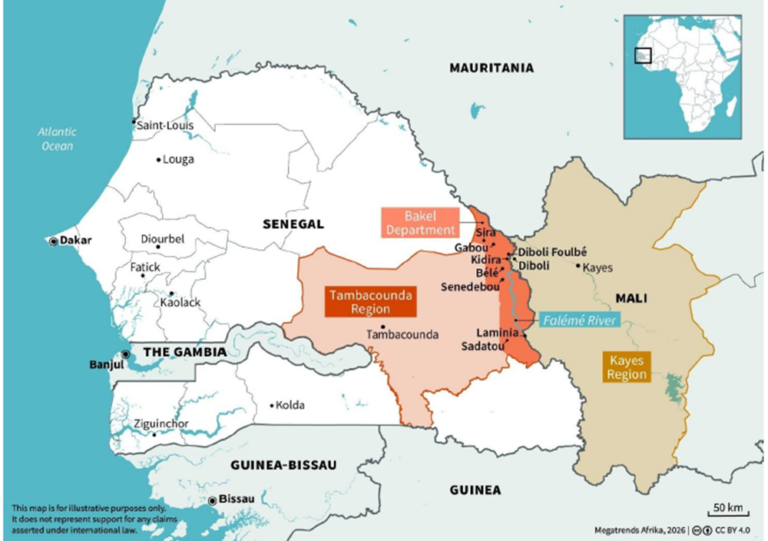
The Bakel department in eastern Senegal is currently at the centre of a complex nexus of security, humanitarian, and environmental crises.
According to a March 2026 report titled “Beyond Jihadism: Security Concerns along Senegal’s Border with Mali,” published by the think tank Megatrends Afrika, residents of this region are balancing the looming threat of jihadist encroachment from neighboring Mali with the immediate, daily realities of surging crime, growing geographic isolation, and the ecological destruction of the Faleme River. Author Hannah Rae Armstrong based these findings on interviews conducted late in 2025 with twenty key stakeholders, including traditional leaders, farmers, traders, and religious figures across the town of Kidira and five surrounding border villages.
The jihadist group Jama’at Nusrat al-Islam wal-Muslimin, or JNIM, which is affiliated with Al-Qaeda, intensified its movements toward southern and western Mali throughout 2025, committing nearly 20 percent of its violent acts in that specific region. While the group has established logistical bases in the Malian Kayes region just kilometers from the Senegalese border, it does not currently exercise territorial control there. A major turning point for the local population occurred in July 2025 when JNIM launched a simultaneous offensive in the Kayes region, including an attack in Diboli, a Malian locality situated only two kilometers from the Senegalese town of Kidira. This was followed in September by the kidnapping of six Senegalese truck drivers, who were released after 24 hours. Despite these incidents, the report suggests JNIM currently lacks the capacity to project significant force into Senegal and likely seeks to avoid direct confrontation with Senegalese defense forces, which are notably better equipped than their Malian counterparts. The economic interdependency remains high, as approximately 70 percent of Mali’s imports and exports transit through the port of Dakar, and Mali accounts for roughly one-quarter of Senegal’s total exports.
Beyond the threat of militancy, residents are grappling with a resurgence in banditry. Three major armed robberies were documented in the final two months of 2025 alone, specifically targeting travelers and public transport in areas with poor cellular coverage. Simultaneously, livestock farmers are facing a significant increase in cattle rustling, with criminals leveraging border security gaps to sell stolen animals in Mali, leading to estimated annual losses in Senegal of over three million dollars. This wave of crime has created a profound sense of isolation, with traders noting that even neighboring villages feel inaccessible due to the dangers of traveling alone.
Environmental degradation further complicates the security landscape, particularly through the pollution of the Faleme River, which serves as the border between the two nations. Since the early 2010s, artisanal and semi-industrial gold mining has contaminated the water with heavy metals and waste, making it unfit for irrigation or consumption and devastating local fish populations. Although President Bassirou Diomaye Faye issued a decree in July 2024 suspending mining within 500 meters of the river’s left bank, and authorities dismantled more than 66 illegal sites by June 2025, the problem persists. The report highlights that the suspension fails to address the impact of large, mechanized semi-industrial operators, and the loss of mining-related livelihoods further weakens the resilience of riverside communities.
Senegal has steadily bolstered its military and security infrastructure in the region over the last decade, including the 2017 deployment of an elite GARSI unit, the 2022 inauguration of a military base in Goudiry, and the establishment of a new gendarmerie research brigade in Tambacounda in 2025. While joint military patrols with Mali were launched in February 2025, the report notes that the increased presence of checkpoints on the road from Kidira to Dakar, which grew from five to more than 20, has led to widespread reports of extortion against truck drivers.
The report also warns of specific vulnerabilities that could be exploited, most notably the risk that ethnic tensions from the Malian conflict might spill over the border. In November 2025, a Malian national was arrested for managing seven WhatsApp groups that used the Pulaar language to incite violence. Furthermore, the arrival of approximately 600 Malian refugees, mostly Fulani women and children, following the July 2025 attacks has generated mistrust among some local residents and officials who have blamed them for the rise in crime without offering evidence. To address these challenges, the report calls for increased investment in roads, health facilities, and schools, particularly in isolated communes like Sadatou, while urging continued security cooperation with Mali and deeper involvement of local communities in the long-term management of the Faleme River.
AC/fss/abj/APA