



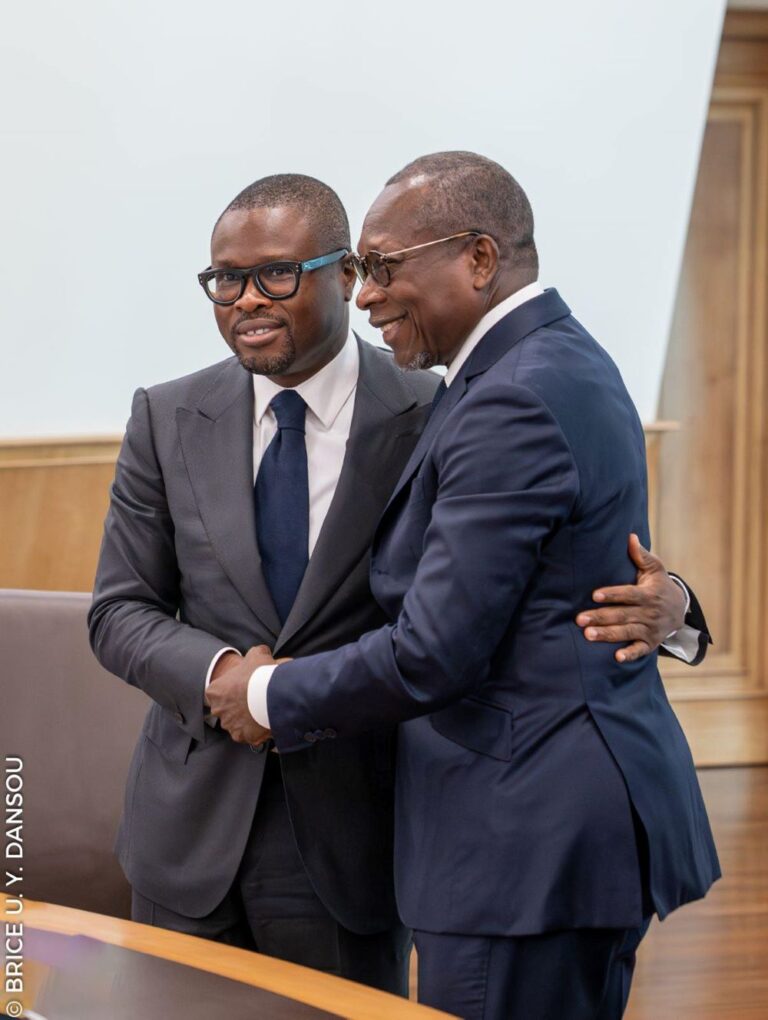
President-elect Romuald Wadagni has assumed the leadership of one of Africa’s smallest and most politically stable countries after taking the oath of office in Contonou on Sunday.
Replacing respected tycoon Patrice Talon, at 49, Romuald Wadagni becomes Benin’s fourth president since the advent of democracy in 1990.
Wagdani and First Lady Nathalie Villette arrived at the presidential palace in Cotonou, where his inauguration ceremony has been taking place.
Representing President Bola Tinubu of neighbouring Nigeria at the ceremony was Vice President Kashim Shettima. A Moroccan delegation representing the monarch in Rabat was also present.
So were former Beninese presidents Yayi Boni and Nicéphore Soglo.
On Thursday, outgoing Patrice Talon delivered a solemn message to conclude a decade in office, praising the “challenges met, the reforms implemented, and the major projects undertaken” during his ten years in charge.
Having come to power in 2016 after a career as a businessman, Patrice Talon leaves behind the image of a leader who profoundly transformed Benin’s administrative and economic system through significant infrastructure and state modernisation schemes.
His record, however, remains contested by a section of the opposition and civil society, particularly after the exclusion of the Les Démocrates party from the 2026 presidential election due to a lack of endorsements, as well as after the adoption of a constitutional reform establishing a seven-year presidential term.
In its decision of April 16, the constitutional court confirmed the election of Wadagni with 4,515,449 of the vote, representing 94.27% of ballots cast.
There was a voter turnout of 63.57%.
Wagdani’s inauguration began at the Marina Palace with a symbolic handover form his predecessor before his formal swearing-in before the constitutional court.
WN/as/APA