





A Canadian company is carrying out early-stage exploration for lithium in Morocco’s Tichla region, according to an internal document circulated by local media.
Lithium Africa Resources has completed mapping and sampling campaigns on a 585-square-kilometre exploration permit in Tichla, work undertaken during the second quarter of 2025, the document said.
No results or estimates of potential resources have been published yet and the project is part of the company’s wider push to expand its African portfolio.
The company specifies that this surface work constitutes a first step before potential drilling campaigns and resource estimation.
The document emphasises that “the surface mapping and sampling programmes
were completed in the second quarter of 2025,” adding that further exploration will depend on the results obtained.
No figures relating to mineral resources are provided at this stage, confirming the absence of a certified assessment.
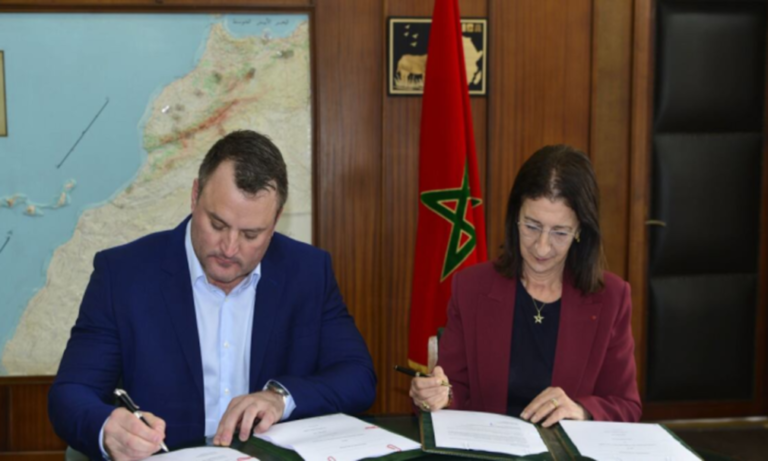
The project benefits from institutional support through a partnership with the National Office of Hydrocarbons and Mines, explicitly mentioned in the document.
This cooperation provides an administrative and legal framework for the project, although the financial details are not specified.
Lithium Africa Resources also highlights its relationships with several African governments to secure access to permits and facilitate the deployment of its activities on the continent.
Beyond exploration, the group links Morocco to an industrial perspective related to lithium processing.
It indicates that “a conversion capacity is emerging in Morocco, compatible with the requirements of the Inflation Reduction Act,” suggesting potential integration into supply chains destined for the American and European markets.
However, no figures are provided regarding industrial capacity or associated investments.
This projection is part of a continental context where Africa remains marginal in lithium exploration budgets, accounting for only seven percent of global spending, compared to more than 80 percent concentrated in a few major jurisdictions.
The group nevertheless believes that this positioning offers potential for development, particularly in relatively unexplored areas like Tichla.
The entire Moroccan project remains structured around a progressive approach, combining geological identification, institutional integration and industrial planning.
In the absence of data on resources or production, the Tichla site remains in the exploration phase for the time being, with development contingent on the results of upcoming campaigns.
MK/AK/te/Sf/fss/jn/APA