





Cote d’Ivoire is accelerating its strategy to exit the Financial Action Task Force (Financial Action Task Force) “grey list”, where it has been placed since October 2024.
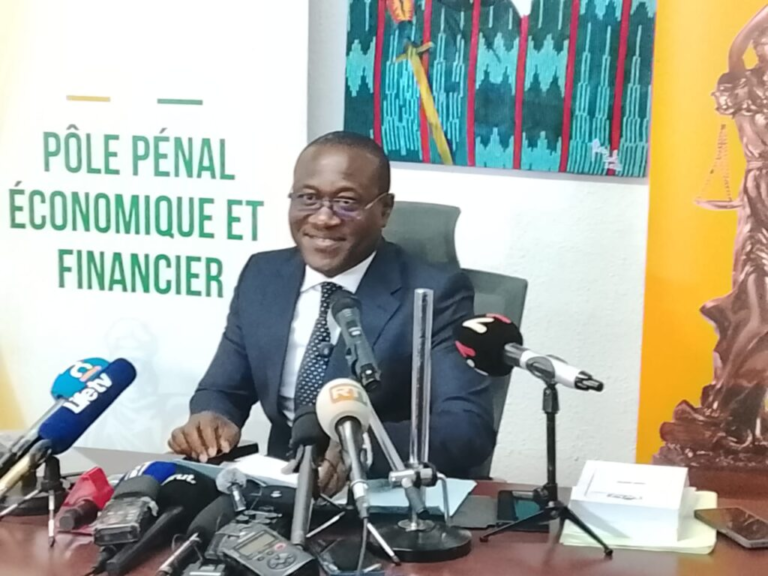
The Public Prosecutor at the Economic and Financial Criminal Division, Jean Claude Aboya, had on Wednesday, June 10, 2026, presented an assertive update on the national anti–money laundering system, which has seen over 1,000 money laundering cases opened.
To more effectively track “dirty money” from corruption, drug trafficking and embezzlement, the Economic and Financial Criminal Division (PPEF) is now relying on a key legal tool: autonomous money laundering prosecution.
According to the prosecutor, money laundering involves introducing “dirty” money into the legal economy in order to give it a “clean” appearance, allowing its use without reasonable suspicion.
Such illicit funds may originate from criminal activities such as corruption, drug trafficking, fraud, or embezzlement of public funds. In traditional cases, prosecution requires proof of the underlying predicate offence.
However, autonomous money laundering, introduced under a 2023 ordinance, allows prosecution even without a prior conviction or identification of the original offence, he stressed.
Unlike conventional procedures, this mechanism enables authorities to prosecute and convict suspects without waiting for proof of the predicate offence. Once financial flows, assets, or material evidence indicate a clearly illicit origin, the financial prosecution unit can act.
“The Financial Prosecutor’s Office will not allow anyone to undermine the collective effort undertaken since October 2024 to restore Cote d’Ivoire’s standing among financially secure nations,” warned Jean Claude Aboya.
Thanks to enhanced investigative techniques, including digital monitoring and proactive investigations, authorities are focusing on high-risk sectors.
The prosecutor specifically identified real estate as a preferred channel used by criminals to launder illicit funds on a long-term basis.
The response is no longer limited to prison sentences, as it now directly targets offenders’ financial assets.
Ongoing cases include major seizure and confiscation measures. To manage these assets, the Asset Recovery and Management Agency (AGRAC) is responsible for organising public auctions.
All of these concrete results are already recorded in an official report published on the FATF website, reflecting Côte d’Ivoire’s transparency in its efforts to restore international financial credibility.
Since its creation in 2020, the Economic and Financial Criminal Division has handled 1,964 cases, issued 819 judgments, seized CFA 15 billion from bank accounts since 2022, and confiscated 97 buildings and thousands of vehicles, according to data released in early May 2026.
AP/Sf/lb/gik/APA