



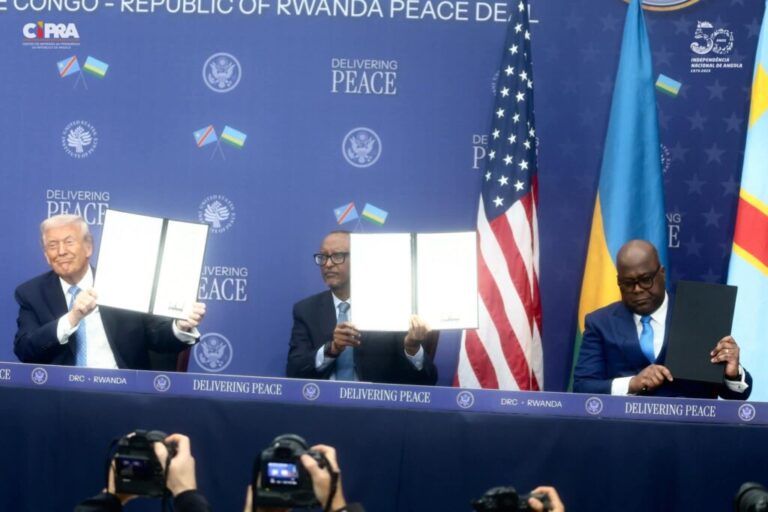
The Democratic Republic of Congo (DRC) and Rwanda signed a historic peace agreement in Washington on Thursday, mediated by U.S. President Donald Trump, signaling an end to more than three decades of deadly conflict in eastern Congo that has displaced millions and claimed over ten million lives.
The Washington Accords, signed by Presidents Félix Tshisekedi of the DRC and Paul Kagame of Rwanda, formalize commitments initially reached in June. The comprehensive document includes a declaration of principles, a permanent ceasefire, disarmament protocols, and a framework for regional economic integration.
The signing ceremony at the United States Institute for Peace (USIP) was marked by a strong international presence. Key African leaders in attendance included the Presidents of Angola, Burundi, and Kenya (William Ruto), the Prime Minister of Togo, the Vice President of Uganda, and the Chairperson of the African Union Commission. Foreign Ministers from the Gulf States, including Qatar and the United Arab Emirates, also participated.
President Donald Trump hailed the agreement as a “historic success,” noting that numerous previous administrations had failed to resolve the enduring crisis. He praised Presidents Tshisekedi and Kagame as “courageous leaders” and announced that the U.S. would dispatch some of its largest companies to support the economic recovery in both countries, alongside new bilateral agreements to facilitate access to strategic minerals.
Both signatory presidents acknowledged the weight of the agreement and the challenges ahead: Rwandan President Paul Kagame expressed deep gratitude for President Trump’s “fair and pragmatic approach.” He accepted the full responsibility for execution: “If things do not unfold as planned, the responsibility will not lie with President Trump. We will be responsible.” He reaffirmed Rwanda’s commitment to regional security and stability.
Congolese President Félix Tshisekedi hailed the signing as a “historic turning point” for the Great Lakes region. He pledged to implement the framework with “seriousness, rigor, and a constant focus on peace and the unity of the territory.” Tshisekedi, however, called for reciprocity, urging Rwanda to respect the agreement, particularly regarding the end of all support for armed groups.
Angolan President João Lourenço, the current Chairperson of the African Union, cautioned that “signing the agreement is one thing, implementing it in a timely manner is another,” stressing the need for shared responsibility among all regional partners.
Kenyan President William Ruto described the Washington agreement as a “transformative agreement for all of Africa,” and called for leveraging African resources to build local value chains that create jobs and prosperity.
The Washington Accords lay the groundwork for a new model of coexistence based on trust, cooperation, and shared prosperity. The framework provides for a permanent ceasefire, the disarmament of armed groups, the return of refugees, and the establishment of transitional justice mechanisms. For the signatories, the agreement marks the beginning of a demanding but hopeful path toward establishing an era of lasting peace in the Great Lakes region.
AC/Sf/fss/abj/APA