






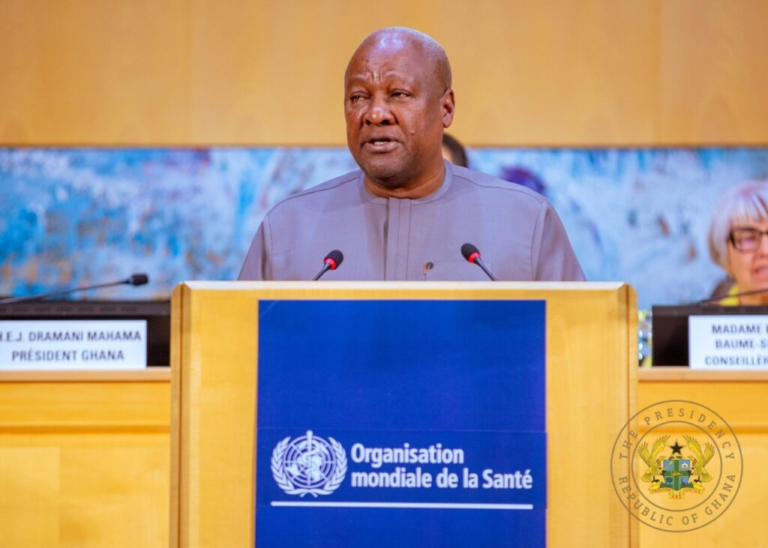
Ghanaian President John Dramani Mahama on Monday urged the international community to move beyond aid dependency and build sovereign, resilient health systems across Africa.
He was speaking in Geneva against the backdrop of collapsing international health aid and the withdrawal of major Western donors from the continent.
Addressing delegates from the 194 member states of the World Health Organization (WHO) gathered for the 79th World Health Assembly (WHA), the Ghanaian leader painted a bleak picture of global health financing, citing a 40% decline in international humanitarian aid and major cuts in official development assistance by leading Western economies.
He noted in particular that Ghana had lost $78 million in health funding following the termination of U.S. aid programmes, resources that had mainly supported malaria control, maternal and child health, nutrition, and the fight against HIV/AIDS. In South Africa, he added, the abrupt withdrawal of PEPFAR funding had forced clinics to shut down and left 1.4 million people living with HIV without guaranteed treatment.
“We did not come to Geneva to mourn the past. We came to build a future where a nation’s health is not a by-product of charity, but the result of sovereign capacity,” President Mahama declared.
Presenting himself as one of the architects of the “Accra Reset” — an initiative launched during the African Conference on Health Sovereignty in August 2025 — the Ghanaian leader argued that cuts in international assistance represented “the final signal that the old donor-dependency model has run its course.”
On the domestic front, he pointed to reforms undertaken by Accra as evidence that health sovereignty is achievable: expansion of National Health Insurance Scheme (NHIS) coverage to 66%, the rollout of a free primary healthcare programme, the injection of an additional $300 million into the health sector through the removal of the insurance fund ceiling, and the creation of the Ghana Medical Trust Fund — dubbed “Mahama Cares” — dedicated to non-communicable diseases. Ghana has also set a target of exiting GAVI vaccine support by 2030.
To reform the global health architecture, Mahama outlined three operational pillars of the Accra Reset: an Independent High-Level Panel on reform, an observatory tasked with coordinating WHO, GAVI and Global Fund strategies, and a mechanism known as Health Investment National Gateway (HING), designed to translate political commitments into concrete investments in local manufacturing and bio-innovation.
He made three key appeals to the Assembly: not to lower ambitions for institutional reform, to invest in implementation rather than declarations, and to measure success “by the clinic, not the conference.”
WHO Director-General Tedros Adhanom Ghebreyesus welcomed President John Dramani Mahama’s presence and praised his leading role in launching the Accra Reset, saying that “the echoes of Accra are now resonating in Geneva and across the world.”
AC/Sf/lb/as/APA