



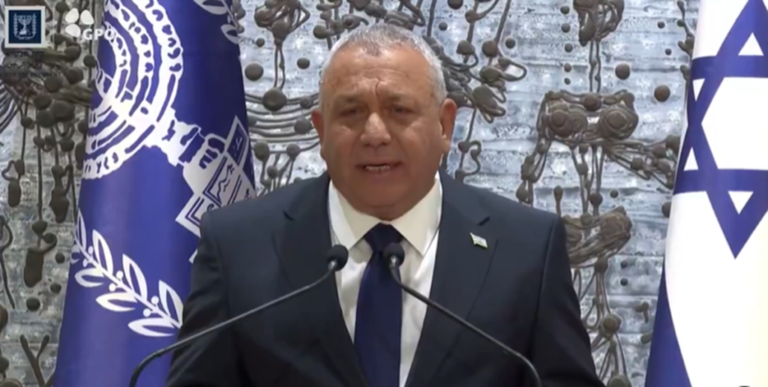
Gadi Eisenkot, leader of the Yashar party, tasked on Sunday, November 8, 2026, by President Isaac Herzog with forming the next Israeli government, has called for the establishment of a “national emergency government.”
According to a statement delivered at the President’s Residence, this government would be open to any political factions willing to adhere to four fundamental principles.
“Israel needs new leadership. Israel needs a new government,” the former Chief of Staff said, describing an emergency situation characterized, in his view, by ongoing conflicts on multiple fronts, a diplomatic crisis, and the weakening of Israeli democracy.
He noted that even Israel’s closest friends and strategic allies are now calling for a reconsideration of their relationships with the country.
Domestically, he pointed to a growing loss of public trust in state institutions and warned of the risk of a further deterioration in the state of democracy.
Gadi Eisenkot indicated that consultations held at the President’s Residence showed, by his assessment, that an absolute majority of lawmakers support a change in government and his own appointment as Prime Minister. He asserted that 74 members of the Knesset no longer have confidence in the outgoing government or its leader, Benjamin Netanyahu.
To form his coalition, he announced that he would soon extend a formal invitation to all political factions represented in Parliament, as well as to individual members of the Knesset.
Prospective partners must commit to four principles: recognizing Israel as a Jewish and democratic state; upholding the values enshrined in its declaration of Independence; establishing a universal service requirement – whether military, national, or civil – for all citizens; and recognizing Hamas as a terrorist organization, with a commitment to dismantling its military capabilities and its governing power.
The former chief of general staff also invited elected officials from the Likud and the Religious Zionist Party to join his initiative, arguing that there could be no justification for their refusal if they were truly in favour of a national unity government.
He warned that forming a new team would require compromises and “creative, unconventional” political initiatives.
“None of us will be able to keep every promise we’ve made,” he stated, calling on political factions to set priorities and act responsibly.
He also affirmed his desire to serve as Prime Minister for all Israeli citizens, regardless of whether or not they voted for him.
According to the Associated Press (AP), Eisenkot has 28 days to form a government, with a potential 14-day extension. His designation follows consultations during which 67 members of parliament recommended his candidacy to the president, compared to 46 for Benjamin Netanyahu, while seven elected officials did not support any candidate.
However, securing a majority remains uncertain; negotiations must, among other things, bridge differences between political factions regarding the participation of Arab parties and the issue of military service for the ultra-Orthodox, the AP notes.
Benjamin Netanyahu has led the Israeli government since December 2022.
As the legislative elections of October 27, 2026, failed to produce an absolute majority, the formation of a coalition is essential to determine who will succeed him at the head of the executive branch.
AC/Sf/fss/gik/APA