



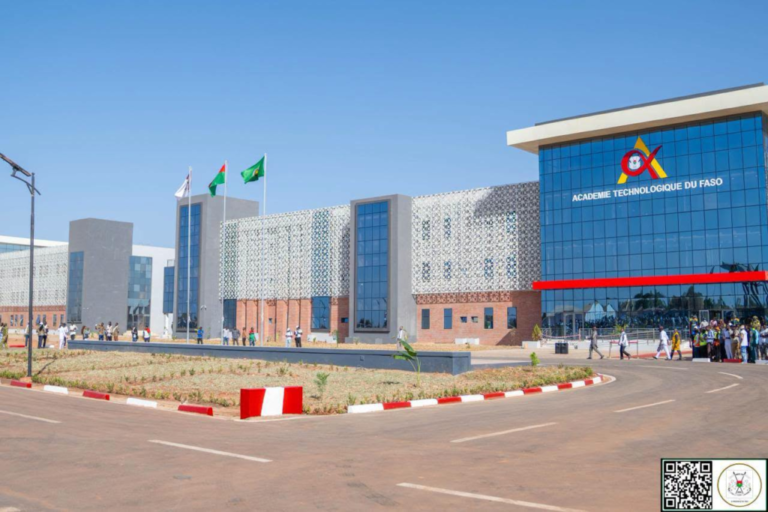
Pabre, a town near Ouagadougou was the centre of attention as Burkinabe President Captain Ibrahim Traore inaugurated the ‘Academie technologique du Fasoe (ATF) on Monday.
The ATF is a 60-hectare university complex designed to train engineers in strategic sectors, including mining, metallurgy, nuclear science, and aeronautics.
It is a new, high-level hub for scientific and technical education built in Pabre on the outskirts of Ouagadougou.
According to information shared during the ceremony, the institution, which spans 60 hectares, was funded through the state budget.
The investment for its construction exceeded 37.3 billion CFA francs (approximately €57 million), according to data presented regarding the project.
Launched in December 2025, the first phase of construction was completed in less than a year, authorities stated. The facility is intended to bolster national capacity for training engineers and
technical professionals in fields deemed priorities for the country’s economic development and sovereignty.
An inaugural cohort of 250 high school graduates – drawn from scientific and technical academic tracks across various regions of Burkina Faso – will begin a two-year preparatory program at the
academy.
Following this core curriculum, students will be directed into various specializations, including nuclear engineering, telecommunications, computer science, digital engineering, chemistry, aeronautics, metallurgy, mining, electrical energy, civil engineering, and cybersecurity.
During the ceremony, the head of state urged students to develop their capacity for innovation and to design technologies that address the country’s needs.
“The day you produce your first engines I will be proud. The day you present your first turboprop engines to me, I will be proud,” stated Ibrahim Traore, according to remarks reported from his address.
He also raised the possibility of future engineers designing aircraft intended, in particular, for the surveillance and defence of the national territory.
In the view of the Burkinabe president, the academy should help reduce the country’s technological dependence, as it still imports a large portion of the equipment used in the health, transport, agriculture, and defence sectors.
He emphasised three requirements for the students: creative ingenuity, boldness, and discipline. He assured that the institution’s laboratories would be equipped gradually, acknowledging that
specialised scientific equipment would require significant investment.
According to the president, more than 1,000 Burkinabe and foreign educators have already applied to teach at the institution.
Speaking on behalf of the inaugural class, the student representative expressed gratitude to the people of Burkina Faso, noting that the creation of the academy was the result of sacrifices made by taxpayers and the forces engaged in defending the nation.
“We will take our training seriously, and we will take good care of this campus,” he declared.
Through this new institution, the Burkinabe authorities are signalling their ambition to develop national expertise in strategic technological fields – such as mining and metallurgy – with the goal
of progressively strengthening the country’s scientific and industrial capabilities.
HO/te/fss/as/APA