



Madagascar Monday reaffirmed its support for Morocco’s territorial integrity and for the autonomy initiative proposed by the kingdom to resolve the dispute over the Western Sahara.
The African nation also strengthened its partnership with the kingdom through the signing of nine cooperation agreements covering several sectors.
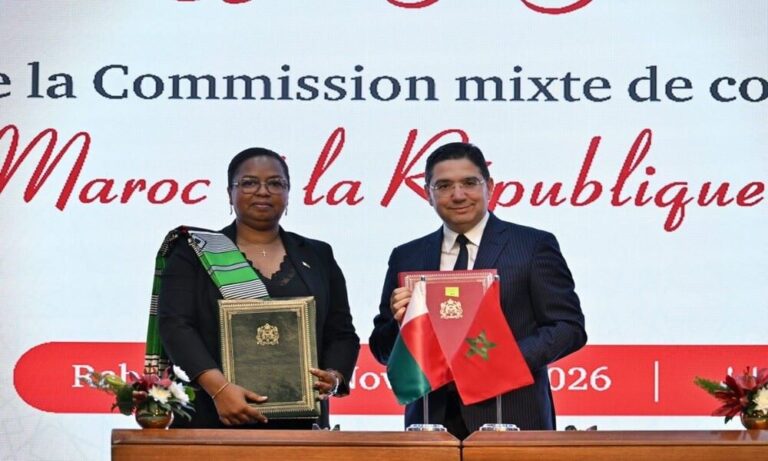
These announcements were made during the second session of the Morocco-Madagascar Joint Cooperation Commission (JCC), held on Monday, November 23, in Rabat, and co-chaired by Nasser Bourita, Morocco’s Minister of Foreign Affairs and Alice Ndiaye, Minister of Foreign Affairs of Madagascar.
In a joint statement issued following the meeting, Madagascar expressed its commitment to respecting Morocco’s sovereignty and territorial integrity, in accordance with the principle of territorial integrity for United Nations member states.
It also voiced its support for the Moroccan autonomy initiative, welcoming UN Security Council
Resolution 2797, which affirms that genuine autonomy under Moroccan sovereignty could serve as a highly viable solution to the dispute over the Western Sahara.
According to Rabat, the position of the Republic of Madagascar aligns with the growing international consensus in favour of autonomy under Moroccan sovereignty – a development driven by the international momentum fostered by King Mohammed VI.
Furthermore, the two countries signed nine agreements designed to expand and diversify their legal framework for partnership. These cover areas such as mutual administrative assistance in customs matters, commercial and industrial cooperation, youth, agriculture, tourism, handicrafts, infrastructure, and the social and solidarity economy.
Other areas addressed include vocational and academic training, the provision of scholarships, internships, and the sharing of expertise.
The second session of the Joint Cooperation Commission (CMC) also served to define new cooperative initiatives across several high-potential sectors, including trade, industry, agriculture, marine fisheries, energy and mining, electricity, and energy efficiency.
Both sides also intend to strengthen exchanges in the areas of water management, meteorology, desalination, wastewater reuse, infrastructure, transport, and the digital sector – with a particular
focus on artificial intelligence.
Regarding education and training, Morocco announced an increase in the quota of scholarships for Malagasy students and trainees, raising the number of available spots from 90 to 200, effective from the upcoming academic year.
This measure will be complemented by capacity-building for instructors and supervisory staff, as well as the tailoring of academic programs to meet Madagascar’s specific needs and its socio-economic development priorities.
During the session, both ministers commended the quality of the historic ties between their two nations, highlighting the significant impact that King Mohammed VI’s 2016 visit to Madagascar had on the advancement of bilateral cooperation.
They also underscored the importance of the opening of the Malagasy Embassy in Rabat in November 2024.
At the same time, Madagascar expressed its appreciation for King Mohammed VI’s vision for the development of Africa, as well as his initiatives aimed at fostering peace, stability, and shared
prosperity.
The Malagasy minister also conveyed her gratitude for the projects carried out – under the king’s direct instructions – by the Mohammed VI Foundation for Sustainable Development. These projects, which span the fields of education, healthcare, training, and human development, have played a vital role in building local capacity and improving the living conditions of the beneficiary populations.
AK/fss/as/APA