



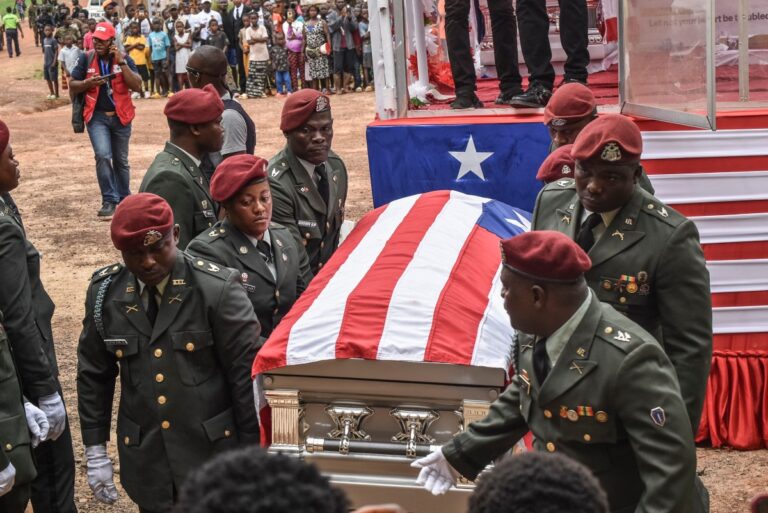
Despite being thirty-five years in the making, the high-profile public sendoff for slain Liberian former President Samuel Kanyon Doe carried with it an unmissable air of mystery about it that was anything but simple.
Last Friday’s state funeral for Doe was President Joseph Boakai’s final wish to give the man he served under as agriculture minister, a repose befitting of his place in Liberian history. It was also part of fulfilling a campaign promise to stem the division originating from Doe’s time at the helm and set the country on a genuine path to reconciliation.
Liberia is observing several days of national mourning for Doe which ends on Friday, July 4th 2025.
”This is not just a burial; it is a moment of national reflection, a time to reconcile with our history, to heal from our wounds, and to remember with respect and purpose” Mr Boakai said.
Attended by Liberia’s high and mighty led by Boakai, the solemn ceremony took place in the biggest city in Grand Gedeh County, only 12 miles from Mr Doe’s hometown of Tuzon whose residents trooped to witness what looked like the remains of their most famous indigene being interred for the final time.
With thousands watching close by and millions of Liberians following the auspicious occasion at home and abroad, the funeral cortege moved with poise and purpose.
”It’s better late than never” said one political commentator, convinced that Liberia was finally closing one of the most intractable chapters of its recent turbulent history which claimed Liberian lives and limbs in their tens of thousands and condemned swathes of the country of then 2 million people to rack and ruin.
Their faces, a mask of joy and sorrow, senior citizens who had witnessed the unforgiving fury of conflict wiped their tears as the two truck-driven coffins draped in Liberian colours coursed their way through to the main town hall where full scale state funeral rites were to be held in honour of Mr Doe. In locked steps, soldiers in full ceremonial regalia brought up the rear while marching to the beat of martial music supplied by a military band.
Mystery amid state pomp
However, despite this impressive state pomp, there was something intriguing about the show which Boakai’s government had orchestrated to appease the demons surrounding a piece of Liberian history that remained unresolved 35 years on, and bring a permanent closure to this troubled past.
One of the coffins carried the remains of Doe’s wife Nancy who in collaboration with Boakai’s government was in the middle of planning a state reburial for her husband when she died in 2024.
The other casket which was supposed to hold the remains of Liberia’s 21st president, the first non Americo-Liberian leader, was empty.
That coffin served a symbolic purpose for a country desperate to bring an end to uncomfortable reminders of the first Liberian civil war which began in 1989, caused Doe’s death and ended in 1997 with his nemesis Charles Taylor installed as president.
The occasion naturally raised past questions about what happened to Mr Doe’s remains and where he was hastily disposed of after being tortured and killed by rebels led by Prince Yormie Johnson who incidentally died last year.
Johnson who was the head of the splinter Independent National Patriotic Force of Liberia (INPFL) from Charles Taylor’s National Patriotic Force of Liberia (NPFL) before he died gave testimony on how Doe’s heavily mutilated body was disposed of by his armed acolytes.
The captured, starkly naked and tightly bound Doe (born in 1951), died of multiple wounds after being subjected to harrowing torture including the gruesome chopping off of one of his ears, while a slightly drunk Johnson enjoyed a draft of beer a few feet away from him.
Testifying during Liberia’s truth and reconciliation commission almost two decades later, Johnson denied rumours that he and his henchmen were cannibals who dismembered the former president’s body and devoured it. He said at the time his men had escorted a foreign journalist to Doe’s grave (he did not indicate where) before it was exhumed in the presence of the unnamed reporter.
”They went to the grave, took a picture and I asked them to burst the grave and bring the body out. The body of Doe was as hard as a rock. Doe was embalmed for 25 years” he told the TRC commissioners.
”Later I told them to rebury the body but my deputy said the dead can’t have two graves so Doe’s body was cremated and then his ashes were thrown into a river”, he further explained.
When asked by one of the commissioners why it was necessary to ‘brutally murder the late president’ when he could have been turned over to The Hague after his capture, Johnson without mincing his words sounded unapologetic, saying it was a justified case of exacting revenge for past killing of his own kinsmen.
”Doe’s regime did not favour my people, he killed them like chicken with no protection under the law. Samuel Doe gave the people of Nimba County sleepless nights. He drove us from the capital and we had nowhere to go”, he explained.
President Boakai led Liberians in keeping with the African tradition of not speaking ill of the dead and showered fulsome praise on Doe.
”His administration laid foundations in infrastructure, education, and industry. Many of these efforts remain visible and relevant today. His dream was to transform Liberia into a nation where every citizen could thrive” Boakai said.
”I speak not only as President, but also as someone who served under President Doe. I served first as Managing Director of the Liberia Produce and Marketing Corporation, and later as Minister of Agriculture.
”Through our work together, I came to know him personally. He was determined. He was sometimes misunderstood. But he was always committed to improving the lives of the Liberian people. Our collaboration was built on mutual respect and a shared vision of national service” the Liberian leader added.
Samuel Kanyon Doe was president of Liberia after staging a violent 1980 coup against William Tolbert who was assassinated.
He became the first non-American-Liberian President of Liberia and ruled with an iron fist for five years before holding widely criticised democratic elections which he won with 51% amid allegations of electoral fraud.
Before the outbreak of the first Liberian civil war, Doe’s regime was criticised for being authoritarian and corrupt and nepotism which favoured his Krahn kinsmen. A brutal crackdown on ethnic Mano and Gio tribesmen followed an abortive coup against him in 1985. By then his rule had become very unpopular both inside Liberia and abroad, culminating in rebels led by Taylor invading the country from neighbouring Ivory Coast with the stated aim of ousting him.
Despite several opportunities offered to him to leave as his army crumbled around him, Doe preferred to stay in Monrovia. This would eventually cost him his life in the hands of Johnson and his henchmen.
35 years on, it falls on President Boakai to pick up the pieces and lead the road to forgiveness and reconciliation.
For Boakai, the reburial reflects national maturity and the collective will of Liberians to heal and underscores his government’s policy of finally casting away the lingering shadows of conflict and foster reconciliation.
WN/as/APA