



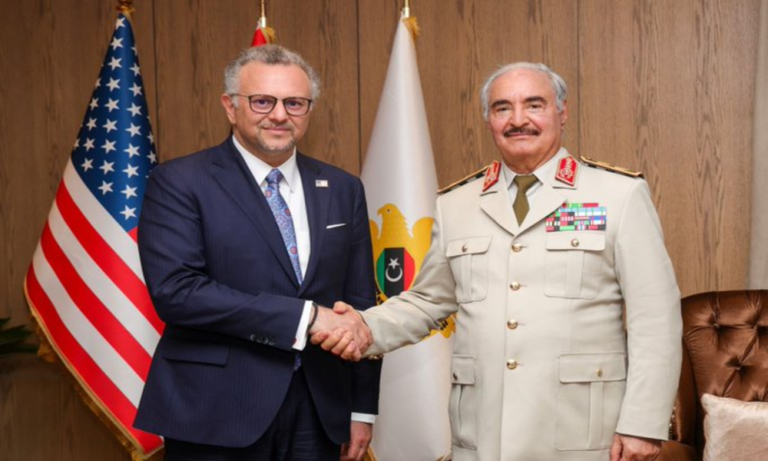
A plan attributed to Massad Boulos, African affairs adviser to U.S. President Donald Trump, raises the possibility of a political deal between Libya’s two main power centers — Marshal Khalifa Haftar and Prime Minister Abdelhamid Dabaiba — bypassing the holding of elections entirely.
According to information circulated by several sources close to the Libyan file, the framework would aim to end the institutional fragmentation that has paralysed the country for years. The central idea would be to establish a political arrangement allowing both camps to remain in power within a reunified government tasked with stabilising state institutions.
Under this configuration, Khalifa Haftar would retain a central role in the security and military apparatus, while Abdelhamid Dabaiba would remain at the head of the civilian executive. The plan envisages a division of responsibilities within a new executive body designed to incorporate the country’s main political and territorial forces.
One of the defining features of the proposal is the absence of a binding electoral timeline. The mandate of the reunified government would not be conditioned on the rapid organisation of presidential or legislative elections — a question that has for years blocked attempts at political transition in Libya.
For its proponents, such an arrangement could offer a pragmatic path toward stabilising the country and restoring the functioning of institutions, in a context marked by the rivalry between competing governments and the persistent influence of armed groups.
Such a deal could nonetheless draw criticism from within Libya’s political class and from certain international capitals, which maintain that the lasting legitimacy of institutions can only be guaranteed through a recognised electoral process.
MK/AK/te/lb/as/APA