





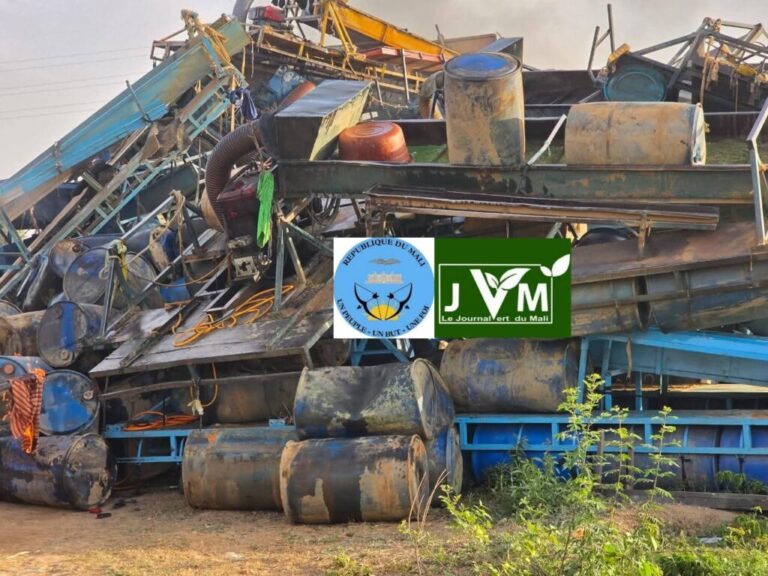
Malian authorities have entered a decisive new phase in their ongoing campaign to eradicate illegal gold mining, conducting a large-scale operation on March 30, 2026, within the Niger River basin.
During this latest intervention, which extended to Katibougou in the rural commune of Mandé, security forces seized and burned 38 dredges. This action follows a series of successful raids across the regions of Koulikoro, Yanfolila, Bougouni, Moribabougou, and Baguinéda, all aimed at enforcing the Malian Mining Code, which strictly prohibits the extraction of minerals from riverbeds via dredging.
The offensive has gained significant momentum since the second half of 2025. A major turning point occurred in July 2025 during the military operation “Djoliba Saniya,” which resulted in the destruction of 206 dredges and six large mills across five locations in the Koulikoro region. Subsequent operations in November 2025 and early 2026 have continued this trend, with dozens of additional machines being decommissioned in Yanfolila and other riverside communities. By combining data from these confirmed phases, it is estimated that more than 290 dredges have been destroyed or seized in less than nine months.
The government justifies these aggressive measures as a necessary step to protect the Niger River, which serves as a vital economic and ecological artery for the nation. Recent environmental studies have raised alarms over deteriorating water quality, severe riverbank erosion, and declining fish stocks caused by mechanical dredging. While the activity has become a primary means of subsistence for some local residents and artisanal miners, the ecological damage to the river—essential for Mali’s agriculture and water supply—has forced the state to prioritize long-term environmental stability.
As operations continue throughout the basin, the persistent pressure on active dredging sites signals a firm commitment by the authorities to halt the practice. Although a final cumulative report for the 2025-2026 campaign has yet to be published, the scale of the destructions in Katibougou reflects an intensifying national debate over the environmental costs of artisanal gold mining versus the economic pressures facing local populations.
MD/ac/Sf/fss/abj/APA