





Mali launched a new initiative on June 16 in Bamako aimed at combating child labour in the Ségou region.
Backed by the Japanese government and the International Labour Organization (ILO), the project also seeks to bolster the economic resilience of vulnerable households.
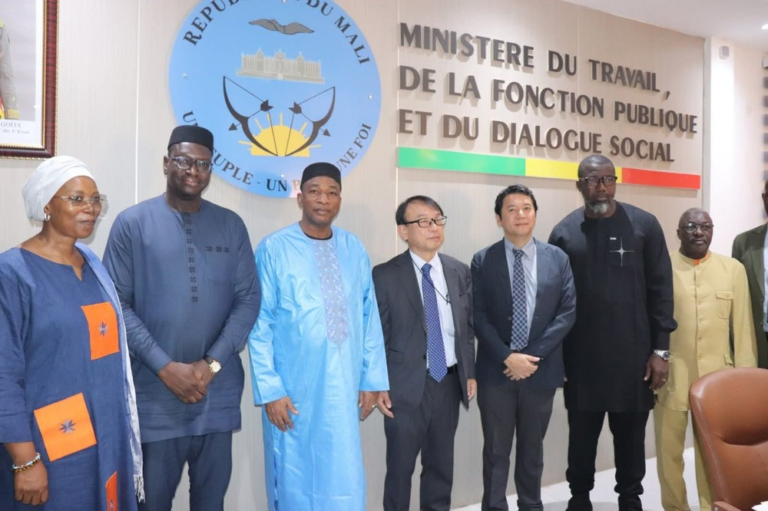
Fassoun Coulibaly, Minister of Labor, Public Service, and Social Dialogue, chaired the launch ceremony for the project, titled “Eradication of Child Labor and Promotion of Economic Resilience in the Ségou Region.” The event was attended by Japan’s ambassador to Mali, as well as representatives from the ILO, the Sasakawa Africa Association, trade unions, and employers’ organisations.
The project will be implemented by the ILO in partnership with the Sasakawa Africa Association. It specifically targets the Ségou region, a major agricultural hub where family-run economic activities frequently expose children to early or hazardous work, particularly within agricultural supply chains.
According to data from the ILO and Mali’s National Institute of Statistics, the country was home to more than 7.1 million children aged 5 to 17 in 2020. Among them, roughly 2.5 million (35%) were engaged in economic activity, and nearly 1.7 million children—representing 28.3% of this age group—were involved in hazardous work.
Over 75% of the children engaged in these activities are between the ages of 5 and 14. Key risks identified include chemical exposure, heavy lifting, handling dangerous tools, excessively long working hours, and being kept out of school.
Mali already possesses a legal framework to combat child labour. The country ratified ILO Convention No. 182 on the Worst Forms of Child Labour in 2000, followed by Convention No. 138 on the Minimum Age for Admission to Employment in 2002. The general minimum age for employment is set at 15, while hazardous work is strictly prohibited for anyone under 18.
Furthermore, the country maintains a national registry of hazardous work forbidden to children, which spans 22 industries and 55 specific tasks. A revised Penal Code adopted in 2024 also cracked down heavily on various forms of exploitation, including human trafficking, sexual exploitation, slavery, and child recruitment.
The primary challenge now lies in the effective enforcement of these laws. By linking child protection with direct economic support for families, the new project in Ségou aims to tackle one of the root causes of child labour: household vulnerability.
MD/te/lb/as/APA