





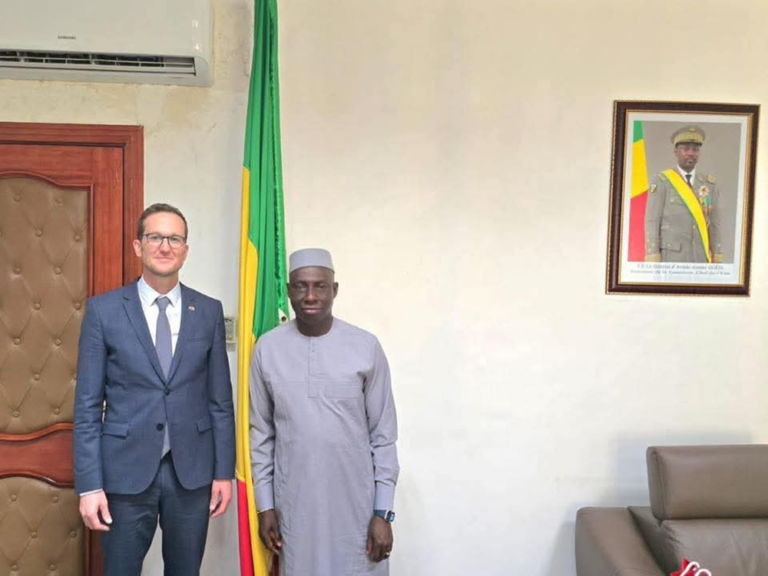
The governments of Mali and Switzerland have formally reaffirmed their long-standing partnership to accelerate rural development, focusing on the systemic strengthening of agricultural value chains and sustainable food security.
The diplomatic alignment was solidified during a high-level meeting in Bamako, where Malian Agriculture Minister Dr. Ibrahima Samaké received Claude Wandeler, the newly appointed head of the Swiss Cooperation Office in Mali. The session concluded with a joint commitment to expand coordinated interventions in rural infrastructure, local capacity building, and market-adapted production frameworks.
Switzerland’s development portfolio in Mali spans nearly five decades, traditionally anchoring state interventions around vocational training, structural food security, and regional peacebuilding. Under the current strategic outlook, Swiss cooperation combines technical innovation with participatory local management to落实 techniques tailored directly to Malian agro-ecological realities. These programs are specifically designed to bridge the gap between smallholder production and institutional markets by improving rural access to technical extension services and resilient farming techniques.
This targeted developmental framework relies on a diverse network of Swiss non-governmental executing partners to deploy specialized solutions across the agrarian sector. For instance, Caritas Switzerland is actively upgrading the technical and entrepreneurial acumen of smallholder farmers, expanding their direct market access while embedding localized climate change adaptation strategies. Simultaneously, the SuisseDev initiative is spearheading the deployment of sustainable, decentralized technologies, introducing solar-powered irrigation infrastructure alongside advanced equipment for processing and food preservation to aggressively reduce post-harvest losses and raise net producer incomes. Furthermore, NGOs like HELVETAS Swiss Intercooperation continue to scale up climate-smart agriculture initiatives, explicitly modernizing regional agrometeorological data networks to provide real-time weather forecasting for rural communities.
This coordinated framework is vital to Mali’s macroeconomy, where nearly 80% of the population depends directly on agricultural livelihoods and the sector generates approximately one-third of national GDP. Swiss technical interventions are calculated to inject structural resilience into this workforce, stabilizing rural farm incomes against intensifying climate volatility. Beyond development aid, the commercial relationship between the two nations remains robust; bilateral trade reached 115 million Swiss francs in 2024, characterized by Swiss exports of high-value pharmaceuticals and specialized industrial machinery paired with imports of Malian gold. Malian authorities concluded the session by emphasizing that structured, long-term technical support is the definitive mechanism required to optimize arable land allocation and shield the country from systemic food insecurity.
MD/ac/lb/abj/APA