





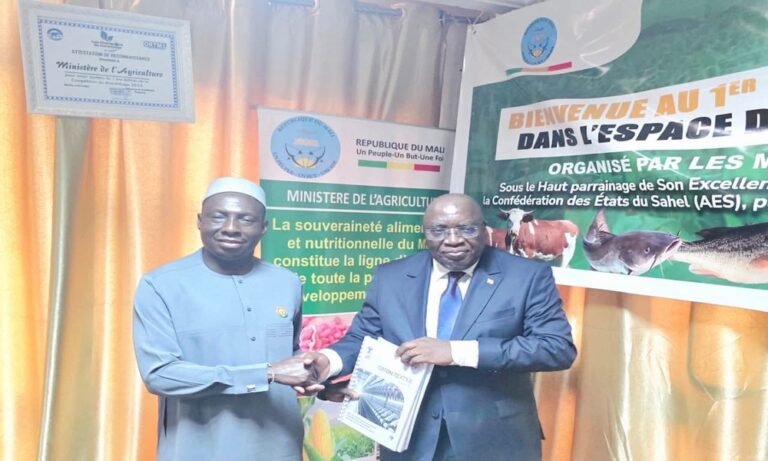
Mali’s Minister of Agriculture, Dr. Ibrahima Samaké, met in Bamako with a high-level delegation from the West African Economic and Monetary Union (UEMOA) Commission, led by Dr. Paul Koffi Koffi, to discuss a massive financing framework targeting three priority agricultural value chains valued at 6,000 billion CFA francs.
The UEMOA delegation arrived in the Malian capital as part of a broader regional tour dedicated to presenting the Commission’s new White Paper. This comprehensive investment portfolio spans the 2026–2040 period, outlining a strategic 15-year roadmap designed to aggressively boost agricultural production and productivity across the entire regional bloc.
At the core of this long-term initiative are the phosphate-fertilizer, rice, and cotton-textile sectors. The deliberate inclusion of phosphate and fertilizers aims to directly eliminate a severe structural bottleneck in West African agriculture, where the prohibitive cost and erratic availability of farm inputs consistently limit crop yields. For Mali specifically, reliable access to affordable fertilizers is a vital necessity that directly dictates the success of major economic sectors, including cotton, rice, and essential domestic food crops.
Rice serves as another central pillar of this regional strategy, driven by the reality that consumption across West Africa continues to climb due to rapid population growth, accelerating urbanization, and shifting dietary habits. Because local output historically falls short of demand, the region remains heavily reliant on expensive foreign imports, prompting regional organizations to prioritize rice as a strategic crop for reinforcing food security and reducing external economic dependence. Concurrently, the cotton-textile value chain forms the third pillar of the White Paper. While all eight UEMOA member states are active cotton producers, local processing capabilities remain low. In Mali, where cotton represents a primary source of rural livelihood, the government’s priority is to expand domestic industrial transformation into textiles and apparel to retain more economic value within producing communities.
This ambitious document aligns closely with UEMOA’s “Impact 2030” strategy and its broader Vision 2040 framework. According to Union data, agriculture remains a cornerstone of the regional economy, generating roughly 21 percent of GDP and providing 53 percent of total employment. Through better integrated regional value chains, UEMOA also aims to more than double intra-community trade, raising it from 13 percent to 30 percent of total trade volume.
These selected agricultural sectors already hold immense weight within Mali’s borders. The country’s paddy rice production reached an estimated 2.88 million tonnes for the 2025 campaign, with projections pushing toward 2.96 million tonnes for the 2025–2026 season across approximately 850,000 hectares. Meanwhile, cotton output for the 2025–2026 season is expected to yield around 433,700 tonnes of seed cotton, with authorities eyeing an ambitious target of 598,500 tonnes for the 2026–2027 cycle.
To secure necessary inputs, Bamako previously approved the purchase of 21,543 tonnes of fertilizer from OCP Africa for approximately 9.8 billion CFA francs excluding tax. This builds on a local production base that, as of 2022, generated 100,000 tonnes of granular natural phosphate and 84,206 tonnes of organic fertilizer—a domestic foundation that the White Paper’s phosphate component is expected to substantially reinforce.
Mali’s Ministry of Agriculture highly welcomed the initiative, praising it as a vital regional cooperation framework for strategic agricultural development. Moving forward, the successful roll-out of the announced funding will depend heavily on establishing clear financing mechanisms, identifying viable local projects, mobilizing international partners, and ensuring the capacity of member states to translate the White Paper into concrete field investments. Ultimately, the immediate challenge for Mali will be effectively linking this sweeping regional framework to pressing local production needs, specifically within the Office du Niger rice basin, key cotton-growing zones, and critical fertilizer supply networks.
MD/Sf/lb/abj/APA