





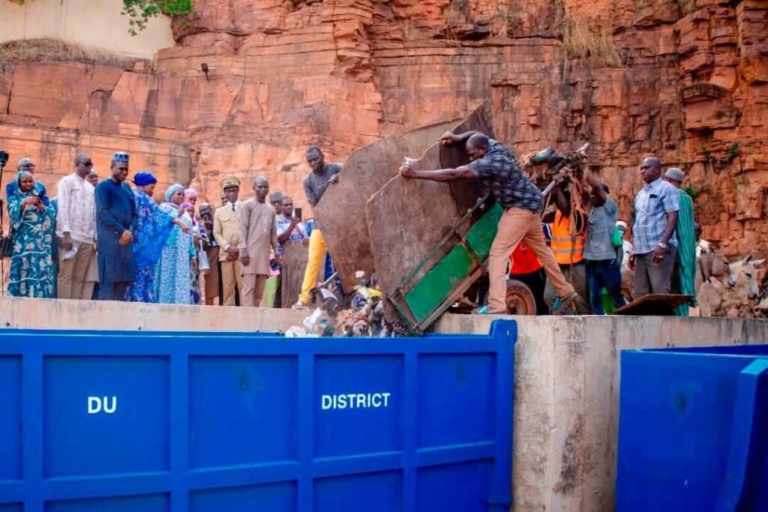
The Malian authorities have commissioned a new waste transit depot and delivered nine specialized vehicles to the Bamako District sanitation services.
This critical upgrade comes as the government allocates an investment of over 864 million CFA francs, or approximately $1.4 million USD, for pre-rainy season sanitation work in Bamako. The capital seeks to aggressively improve solid waste management and mitigate severe flood risks during the ongoing monsoon. The official ceremony was presided over by the Minister of Territorial Administration and Decentralization and Government Spokesperson, Brigadier General Issa Ousmane Coulibaly, alongside the ministers of Transport and Environment.
Located in the second arrondissement, the new transit depot was constructed at a cost of more than 356 million CFA francs. Financed by the national budget through the National Agency for Local Government Investment, this infrastructure aims to streamline waste collection, consolidation, and transfer in an area of the capital where sanitation needs remain critical. Concurrently, the Bamako District Municipality handed over the nine specialized vehicles to the Directorate of Urban Sanitation and Road Services. Purchased with municipal funds for 508 million CFA francs, the new fleet—supplied by the Malian company TOGUNA Motors—includes five seven-cubic-meter tipper trucks, three hooklift trucks designed for 20-cubic-meter containers, and one hooklift truck equipped with a 10-cubic-meter container to boost street sweeping and solid waste disposal.
This heavy investment comes at a time when the capital’s municipal services are under severe strain. According to estimates from the Bamako Urban Resilience Project, the district generates roughly 2,000 metric tons of solid waste per day. The data also highlights a troublesome proliferation of illegal dumping sites and a chronic shortage of the equipment needed to ensure regular waste collection and transfer. Upgrading public works resources is a core component of the city’s flood prevention strategy, and for 2026, authorities plan to clear 241 kilometers of gutters and 85 kilometers of primary drainage channels across Bamako. Furthermore, the Crisis Coordination and Management Center has been placed on high alert through November 30 to improve emergency preparedness and response during the rainy season.
Every year, torrential rains cause extensive damage in the capital due to rapid urbanization, the occupation of flood-prone areas, clogged gutters, and accumulated trash that block waterways and heighten the risk of severe flooding. Under these conditions, solid waste management serves as a critical preventive lever alongside dredging drainage infrastructure and clearing restricted public easements. While the new infrastructure and equipment are set to boost the operational capacity of municipal services, their ultimate success will hinge on regular collection schedules, proper equipment maintenance, the smooth operation of transit depots, and closer coordination between local authorities, technical services, and residents. Bamako is banking on this upgraded equipment to keep rising waters at bay, with the main challenge moving forward being to turn these new resources into a continuous, high-performing public service.
MD/te/Sf/lb/abj/APA