





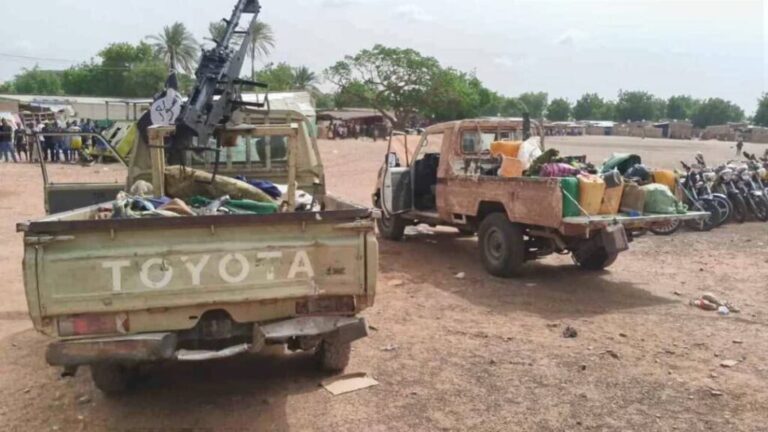
The Malian army reports successfully repelling coordinated jihadist attacks across its central and western regions, while simultaneously announcing the capture of an influential Islamic State in the Sahel (ISIS) leader in the country’s north.
These operations signal a tactical escalation by the Malian forces, yet also highlight the persistent and multifaceted threat posed by extremist groups throughout the nation.
Following a day marked by intense clashes on Tuesday, July 1, the Malian Armed Forces (FAMa), supported by elements of the African Corps (a Russian contingent officially integrated into Mali’s defense system), claim to have repelled simultaneous assaults by the Group for the Support of Islam and Muslims (JNIM) on seven strategic locations: Niono, Molodo, Sandaré, Gogui, Nioro du Sahel, Kayes, and Diboli.
In Niono, a critical point in the Ségou region, approximately a hundred jihadist fighters attempted to overwhelm Malian positions, according to a publication by Africa Corps. The Malian general staff reported neutralizing over 80 attackers, seizing several weapons, and taking prisoners. While JNIM claimed responsibility for the operation, acknowledging prolonged fighting, they also asserted inflicting heavy losses on the army and capturing military equipment.
In Diboli, a town on the Senegalese border, attackers directly targeted state security posts. Witness accounts and authenticated videos obtained by APA show administrative buildings riddled with bullets. This marks the first time a post so close to Senegalese territory—less than two kilometers from Kidira—has faced such a direct assault, despite the recent deployment of joint Mali-Senegal patrols in the area. Despite the coordinated and spectacular nature of these attacks, Malian authorities emphasized their capacity for rapid and coordinated response. Statements from FAMa and the African Corps highlighted their control of operations and the recovery of a significant enemy arsenal. Local sources in Niono and Kayes also reported several jihadists killed.
These developments coincide with FAMa’s announcement of a significant capture in Gao: Abraham Boubacar, alias “Oubel,” identified as the leader of ISIS’s Terrorist Action Group (TAG) in the Tessit sector. He was arrested on June 29 along with ten of his men. Malian intelligence services hail this as a major capture in a region where ISIS remains active, particularly along cross-border routes with Burkina Faso and Niger. This operation was swiftly followed, less than 24 hours later, by the neutralization of another ISIS leader, “Abou Dahdah,” near Menaka. Abou Dahdah was presented as an explosive device specialist and a key ideologue for the group. According to observers, this sequence of events reflects increasing pressure exerted by Malian forces on the command structures of both ISIS and JNIM.
Nevertheless, these tactical successes, while notable, remain fragile and localized. Armed groups in Mali continue to demonstrate a strong capacity for inflicting harm and adapting their tactics. The simultaneous nature of the attacks and the targeting of a border post underscore the limitations of current security measures, even when reinforced by regional cooperation efforts.
Beyond the blows dealt to these jihadist groups, the current situation highlights a broader reality: Mali is engaged in a war of attrition. Each military victory, therefore, must be politically and security-wise consolidated to ensure its lasting impact.
AC/Sf/fss/abj/APA